Franchise vs Independent Cafe in Korea: Which Model Actually Makes Sense for Foreign Brands?
The South Korean peninsula presents a unique economic landscape where coffee consumption transcends habit and enters the realm of cultural necessity. Known widely as the Republic of Coffee, the nation has seen its South Korea Coffee Market grow at a staggering rate over the last two decades.
As of 2023, the average adult in South Korea consumed approximately 367 cups of coffee annually, which represents more than double the global average. For any entrepreneur considering opening a cafe in Korea, understanding the tension between high-volume Franchise Cafe Korea operations and the hyper-aesthetic Independent Cafe Korea sector is the first step toward long-term viability.
The market reached a valuation of approximately USD 12.46 billion between 2018 and 2024 and is projected to climb to USD 31.45 billion by 2034. This growth is not merely a reflection of increased consumption but is tied to the evolution of Seoul Cafe Culture, where the cafe serves as a secondary office, a social hub, and a “little luxury” in an increasingly high-pressure society.
However, the density of every cafe in Korea has reached a point of extreme saturation, with over 100,000 coffee shops operating nationwide as of 2023. This level of competition creates a silent crisis for many operators, characterized by razor-thin margins and high closure rates.
Market Segmentation and Revenue Projections
The South Korea Coffee Market is segmented primarily into roasted and instant coffee. While roasted coffee held the largest revenue share of 61.8% in 2024, the instant coffee segment is witnessing the fastest growth due to a busy lifestyle and the rising popularity of high-quality coffee pods and capsules.
| Market Indicator | 2024 Baseline | 2030 Projection | 2034 Projection |
| Market Revenue (USD) | 5.00 Billion | 7.62 Billion | 31.45 Billion |
| CAGR (2025-2030) | 7.3% | 7.3% | 9.7% |
| Total Outlets | 102,000 | N/A | N/A |
| Per Capita Consumption | 367 Cups | N/A | N/A |
Source: Grand View Research and Expert Market Research
The projected growth is fueled by a demographic shift where Millennials and Generation Z account for 39% of all cafe visits. These age groups prioritize experience, aesthetics, and digital shareability over simple caffeine intake. This shift suggests that any successful Korean F&B Industry strategy must balance operational speed with high-concept branding.
The Franchise Model: Structural Safety and Mandatory Constraints
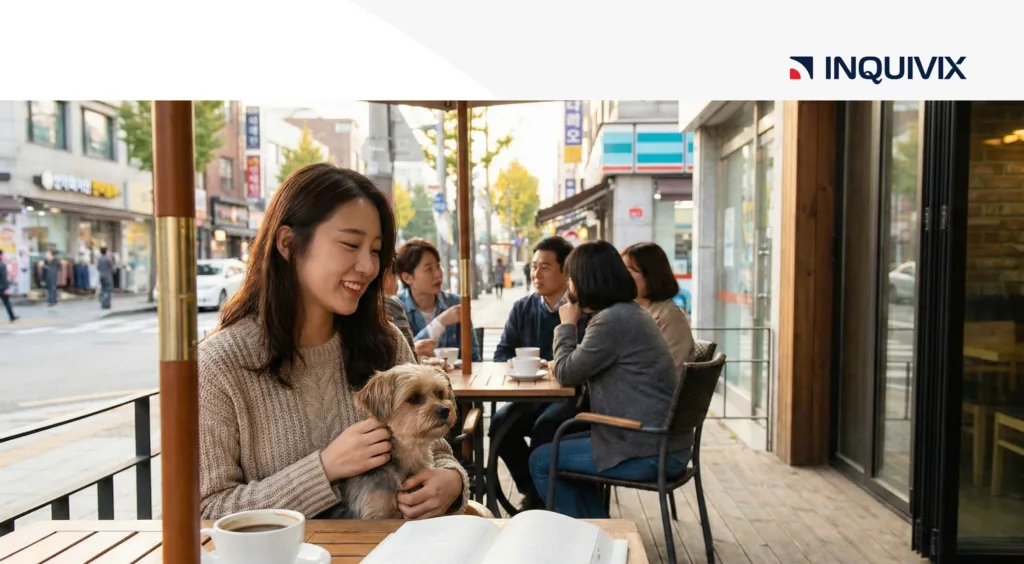
Choosing to open a Franchise Cafe Korea is often the default path for foreign brands seeking rapid market penetration. The model offers a turnkey infrastructure that handles everything from interior construction to supply chain management.
The Mechanics of Rapid Scaling
In the Korean F&B Industry, franchise brands like Mega MGC Coffee and Paik’s Coffee have achieved explosive growth by targeting the low-cost, high-volume segment.
Mega MGC Coffee, for instance, surpassed 4,000 outlets by late 2025, driven by consumers who flock to affordable, large-sized beverages during economic downturns. The franchise model allows an operator to open a cafe in Korea within 60 to 90 days because the headquarters manages the training of non-professional staff and the installation of standardized equipment.
However, this speed comes at the cost of operational rigidity. Franchisees are typically locked into mandatory purchasing agreements, requiring them to buy 100% of their beans, milk, and packaging from the franchisor. These items are often marked up higher than open-market prices, leading to a situation where net profit remains stagnant even as sales volume increases.
Regulatory Oversight and the Fair Trade Commission
The Korea Fair Trade Commission (KFTC) has become increasingly active in protecting franchisees from Gap-Eul relationships, which refers to the power imbalance between a large franchisor and a small owner.
In 2025, the KFTC introduced comprehensive measures to strengthen franchisee rights, including the franchise information disclosure system and the right for franchisees to organize associations.
This signals a tougher regulatory environment where a Franchise Cafe Korea operator must be transparent about all hidden costs and must-buy items.
Independent Cafes: The Experience Economy and Aesthetic Dominance
The Independent Cafe Korea sector thrives in neighborhoods like Seongsu-dong, often called the Brooklyn of Seoul. Here, the focus is on industrial heritage, sensory-rich environments, and specialty coffee roasts.
Sensory-Rich Environments and Brand Authenticity
Korean Consumer Behavior has evolved to view cafes as experiential micro-destinations. Successful independent cafes like Cafe Onion and Daelim Changgo have leveraged urban regeneration by transforming old rice mills and warehouses into high-concept spaces. These establishments provide more than coffee. They offer a narrative that combines history, architecture, and instagrammable aesthetics.
For an Independent Cafe Korea, the lack of a standardized menu is a competitive advantage. Owners can pivot rapidly to meet seasonal trends, such as the massive Dubai Chocolate craze or strawberry-themed spring menus, without the bureaucratic delays of a franchise headquarters. This flexibility is essential in a market where consumers have short attention spans and a high demand for innovation.
The Digital Verification Barrier
The primary challenge for an Independent Cafe Korea is the Verification Gap. In most global markets, discovery happens on Google or Instagram, but in Korea, a brand must be fully integrated into the Naver ecosystem to survive.
If a user sees an attractive photo on Instagram, they will immediately search for the cafe in Korea on Naver to check Receipt Reviews and find the exact location. An independent cafe that fails to master Naver SEO remains functionally invisible to the majority of the domestic audience.
Comparative Analysis of Cafe Startup Costs in Korea
The Cafe Startup Costs Korea involve high fixed overheads that are often misunderstood by foreign investors. The capital structure is defined by the high cost of real estate and non-refundable fees.
Bojeung-geum, Gwonri-geum, and Real Estate
The Korean commercial real estate market operates on a three-tier cost system:
- Bojeung-geum (Security Deposit): These are exceptionally high compared to Western markets, often ranging from KRW 30 million to over KRW 100 million in popular districts like Gangnam.
- Gwonri-geum (Premium): This is a non-refundable transfer fee paid to the previous tenant for their existing facilities and established customer base. In high-traffic areas, the Gwonri-geum can exceed the actual construction costs of the cafe.
- Monthly Rent and Maintenance: These are fixed costs that do not change regardless of sales fluctuations.
| Expense Item | Franchise Model (Est. USD) | Independent Model (Est. USD) | Notes |
| Franchise Fee | $20,000 – $50,000 | $0 | Upfront cost for brand usage. |
| Interior/Remodeling | $100,000 – $250,000 | $50,000 – $500,000 | Franchises have fixed contractors. |
| Equipment | $60,000 – $150,000 | $30,000 – $200,000 | Used equipment can save 30-50%. |
| Bojeung-geum | $30,000 – $100,000 | $30,000 – $100,000 | Refundable but locks up capital. |
| Gwonri-geum | $50,000 – $200,000 | $50,000 – $200,000 | Non-refundable transfer fee. |
| Marketing (Initial) | $0 (included in HQ) | $10,000 – $30,000 | Crucial for independent brands. |
Investors should budget for a 36-month runway, as the average time to recover the initial investment for a cafe in Korea is between 24 and 31 months. Successful management of liquidity during the pivot point at 24 months is the difference between survival and failure.
Labor Laws and the Effective Cost of Employment
Navigating Labor Laws South Korea requires moving beyond the hourly minimum wage. For 2026, the Minimum Wage Commission set the rate at KRW 10,320 per hour.
The Impact of Juhyu-sudang (Weekly Holiday Pay)
The most critical hidden cost in the Korean F&B Industry is the Weekly Holiday Pay. Under the Labor Standards Act, any employee who works more than 15 hours per week is entitled to one paid day of rest.
The calculation for the effective wage is as follows:
Effective Hourly Rate = Minimum Wage × 1.2
Using the 2026 rate, this results in an effective cost of KRW 12,384 per hour.
Social Insurances and Severance Pay
Employers are legally obligated to register all employees for the Four Major Social Insurances including National Pension, Health Insurance, Employment Insurance, and Industrial Accident Compensation Insurance.
Additionally, any worker who has been with the company for at least one year is entitled to Severance Pay (Taejikgeum), which equals approximately 30 days of average wages for each year of service.
Compliance is non-negotiable, and from late 2025, employees can claim up to triple damages for deliberate wage delays.
Digital Infrastructure: Mastering the Naver Ecosystem
The success of any cafe in Korea depends on its digital footprint. Unlike global markets where Google dominates, Korea relies on Naver for local search and decision-making.
Naver SEO and Smart Place Optimization
For a Franchise Cafe Korea, local search rankings act as digital rent. Every location must be optimized on Naver Smart Place, ensuring that photos, menus, and business hours are accurate and enticing.
The Receipt Review system is the most trusted form of social proof in the country, and seeding initial positive reviews is a standard practice for successful launches.
Short-Tail Keywords and Cultural Cues
Naver SEO strategies in Korea differ from Western SEO. Korean users prefer short-tail keywords over long-tail queries.
For example, instead of searching for “how to find a good cafe in Korea in Myeongdong,” a user will simply search Myeongdong Matjib which means Myeongdong tasty place. Furthermore, brands must account for transliteration gaps, ensuring their digital presence covers all phonetic variations of their foreign name in Hangul.
Case Studies of Foreign Brand Performance
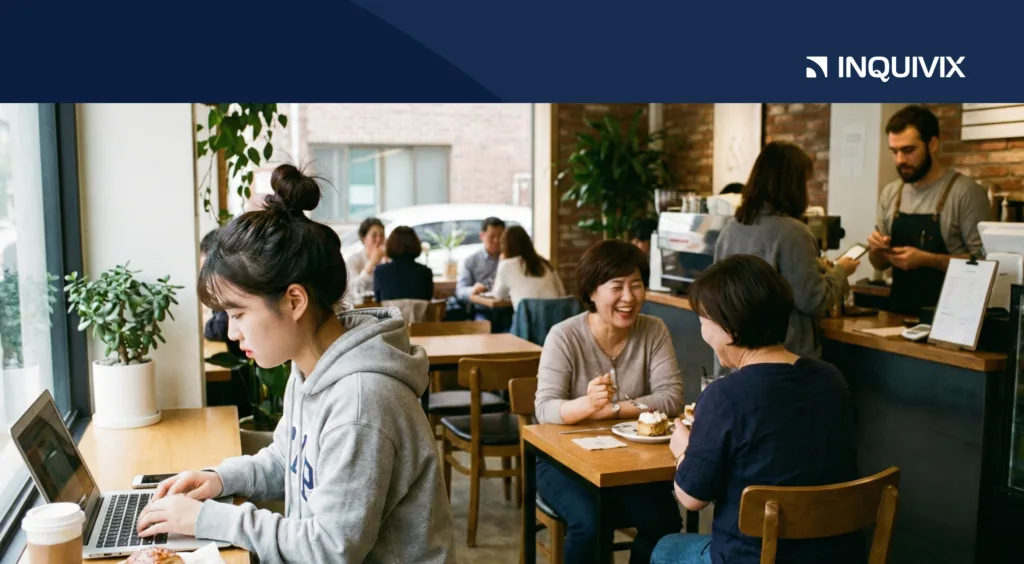
The history of foreign brands in the South Korea Coffee Market is a mix of massive success and cautionary tales.
Success: Starbucks and the Premiumization Strategy
Starbucks has successfully navigated the market by leaning into the Little Luxury trend. By offering a consistent, high-quality third space, they have built a level of brand loyalty that allows them to maintain higher price points than local low-cost chains.
Their success is also attributed to their integration with local delivery apps like Baemin and Coupang Eats, which now account for a significant portion of their sales.
Challenge: Tim Hortons and Blue Bottle
The Canadian brand Tim Hortons faced rumors of market withdrawal early in its Korean tenure, illustrating that even a globally recognized name is not immune to the pressures of a saturated market.
Similarly, Blue Bottle, known for its Apple of the coffee world aesthetic, had to adapt its craft-only model to include local delivery apps to meet the Ppalli-Ppalli culture of Korean consumers.
Failure: Gloria Jean’s
The exit of Gloria Jean’s from markets like Vietnam and Pakistan provides a warning for a cafe in Korea entrant. The primary reason for failure was a lack of attention to local tastes and an over-reliance on a Western model that did not resonate with the Danjjan preference of Asian palates.
Strategic Entry Models for Foreign Brands
When considering F&B Market Entry Korea, the choice of partnership model determines the balance between control and risk.
Master Franchise Agreement
This is the most popular vehicle for rapid expansion. A foreign brand grants rights to a local partner, like SPC Group, who then handles the sub-franchising and operational management.
- Best For: Rapid scaling and leveraging existing local distribution channels.
- Risk: Potential loss of brand control and the need for high trust in the local partner.
Joint Venture
A Joint Venture involves creating a new legal entity shared by the foreign brand and a Korean company.
- Best For: Brands that want to maintain significant influence over the menu and brand identity while sharing financial risk.
- Risk: Complex governance structures and potential for cultural misalignment in management.
Direct Investment
The foreign brand opens its own subsidiary and manages stores directly.
- Best For: Brands like Blue Bottle that prioritize Craft and total control over the customer experience.
- Risk: Extremely high capital requirements and the lack of an existing local network to navigate the Bojeung-geum and Gwonri-geum traps.
The 24-Month Failure Wall: Predicting Structural Collapse
In the Korean F&B Industry, the 24-month mark is a critical threshold. Many businesses fail at this stage not due to a lack of customers, but due to structural and financial pressures that become unsustainable.
Mandatory Interior Remodeling
Franchise agreements often contain a clause requiring the franchisee to remodel their store every 24 to 36 months to keep the brand image fresh. These renovations are funded entirely by the owner and often occur just as they are beginning to recoup their initial investment. Failure to comply can result in contract termination, leading to a renovate or terminate crisis.
Equipment Lifecycle and Warranty Expiration
High-volume espresso machines, ice makers, and automated kiosks are the workhorses of the cafe in Korea. By the second year, initial warranties often expire, and the cost of maintaining these systems can begin to outpace monthly profits. In a low-cost model where an Americano sells for KRW 1,500, even a minor repair can wipe out the margin for hundreds of cups of coffee.
Future Trends: Automation and the Health-Conscious Consumer
As we look toward the next decade of the South Korea Coffee Market, two major trends are emerging: automation and wellness.
Robotic Baristas and AI Integration
To combat the rising Labor Laws South Korea costs, many franchises are turning to automated service models. Robotic arms for coffee extraction and self-service kiosks are becoming standard in high-traffic urban areas.
However, operators must beware of the Technology Trap, where a system failure leads to a total loss of revenue because the store is no longer staffed to handle manual payments.
The Rise of Plant-Based and Functional Beverages
Reflecting a global shift toward sustainability, Korean consumers are increasingly demanding dairy alternatives and health-focused options like keto-friendly or gluten-free beverages. Successful brands will be those that integrate these wellness elements without sacrificing the indulgent Danjjan flavor profiles that dominate the market.
Which Model Makes Sense for Your Brand?
The decision between a Franchise Cafe Korea and an Independent Cafe Korea depends on the specific Core Competency of the foreign brand.
The Franchise Cafe Korea model is ideal for brands that prioritize volume and have a replicable, turnkey business system. It is the model for those who want to compete in the Caffeine as a Utility space. However, success requires a massive capital reserve to handle the 24-month remodeling cycles and the rigid supply chain costs.
The Independent Cafe Korea model is superior for brands that are Aesthetic-First and want to capitalize on the Seoul Cafe Culture of luxury and experience. This model offers higher net margins and the ability to pivot with local trends. The risk of brand invisibility must be mitigated by a Digital-First marketing strategy that prioritizes Naver SEO and influencer verification.
For a foreign brand entering this market, the most viable path is often a hybrid approach:
- Launch a high-concept independent flagship in a district like Seongsu or Hannam to build brand prestige and Insta-credibility.
- Once the brand is verified by the local audience, use a Master Franchise Agreement with a reputable Korean partner to scale the model across the country.