The Real Cost of Opening a Franchise Cafe in Korea (Rent, Labor, Hidden Fees)
The cost of opening a franchise cafe in Korea has stabilized as of early 2026, yet operational overhead remains high. Data indicates that while total store numbers saw a 1.9% decline in 2025, the demand for premium and specialized outlets remains consistent. For international investors, this environment marks a transition from a high-growth market to one defined by professionalized competition and tighter profit margins.
The initial “sticker price” provided by franchisors is rarely the primary financial hurdle for new market entries. Instead, operational pressure is driven by a structural landscape where high security deposits, rising labor floors, and a mandatory “marketing tax” accelerate cash burn throughout the first 12 months. Success in the Korean cafe industry depends on evaluating the total cost of ownership rather than focusing solely on setup capital, ensuring sufficient liquidity to survive the transition from an initial launch to a sustained local business.
On paper, café franchise margins in Korea look workable. In practice, rent, labor, mandatory fees, and sustained marketing costs compress them far earlier than most projections assume. For foreign operators, the critical miscalculation is not the startup capital, but how quickly cash burn accelerates when discovery and conversion depend on paid visibility after month six.
Market Reality: The Cost Structure of Korean F&B
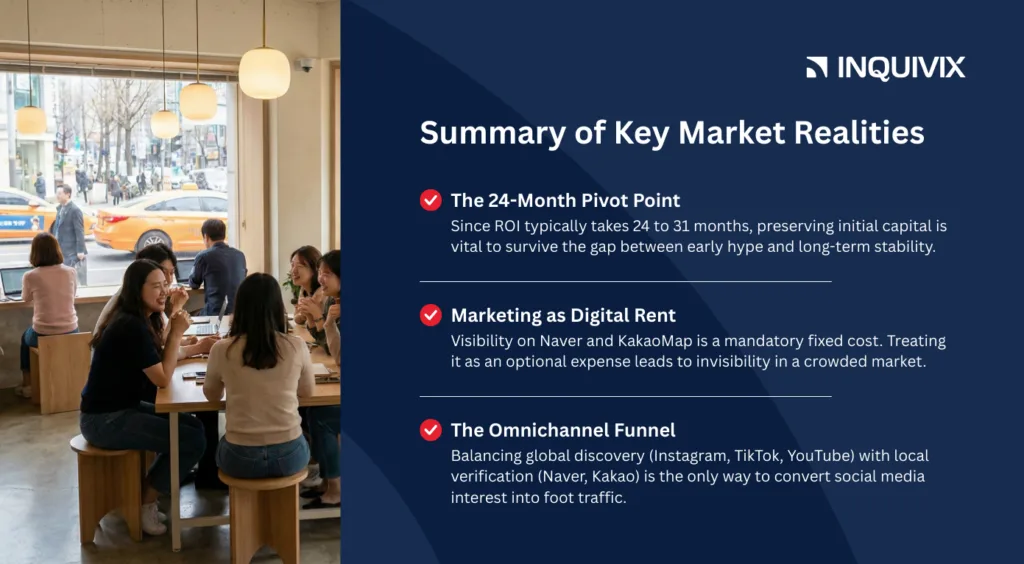
The South Korean café market is defined by a rigid cost structure that determines long-term survival. For a cafe business in Korea, the first 24 months act as a “pivot point” where initial funding often runs low just as operational maintenance costs begin to rise.
The 24-Month Survival Gap
Recent 2025 industry research shows that the average time required to recover an initial investment is between 24 and 31 months. This is significantly longer than the 12-to-18-month estimates often cited in sales brochures.
- The Revenue Plateau: Most new stores see high interest for the first six months, followed by a decline in foot traffic. If a loyal local customer base is not established by month 18, overhead costs usually begin to overtake income.
- Contract Risks: Lease and franchise agreements often face their first major price reviews at the two-year mark. These adjustments can destabilize a business already operating on thin margins, especially given the low survival rates reported for the sector.
Fixed vs. Variable Costs
The Franchise Cafe Economics Korea is characterized by high fixed costs that do not change even if sales drop.
- Supply Chain Lockdown: Franchisees must buy raw materials (beans, milk, packaging) exclusively from headquarters. In 2026, while global coffee bean prices have fluctuated, these “locked-in” costs remain high for the owner, even when local competition forces lower drink prices.
- The Rent Trap: While store income varies, the Korea cafe rent cost is a fixed monthly burden. In popular districts like Seongsu or Gangnam, even a small rent increase requires a massive jump in daily sales just to break even.
Margin Compression
Independent cafés can change suppliers to reduce costs, while franchise outlets are usually required to buy from approved vendors. This limited flexibility increases operating expenses. As costs such as electricity and logistics continue to rise in 2026, profit margins become smaller. Many franchise cafés begin to face financial difficulties by the end of their second year if they do not have sufficient cash reserves.
Operational Expenses: Rent, Labor, and Logistics
Operating a franchise in South Korea involves specific legal and financial obligations that differ significantly from other international markets. These fixed operational costs often represent the largest drain on a café’s monthly revenue.
Commercial Real Estate: Deposits and Premiums
The Korea cafe rent cost is structured around a three-tier system: the security deposit, the premium, and the monthly maintenance fee. According to the Korea Real Estate Board, commercial rent indices remain a primary driver of overhead in Seoul.
- Security Deposit (Bojeung-geum): Korean commercial deposits are exceptionally high, often ranging from 30 million to over 100 million KRW. While refundable, this locks up a significant portion of capital.
- Premium (Gwonri-geum): This is a non-refundable “transfer fee” paid for a location’s existing facilities and customer base. In high-traffic districts, this fee can exceed the initial setup cost of the franchise itself.
- Maintenance Fees (Gwalli-bi): These are monthly building management fees separate from the base rent.
Labor Cost Cafe Korea: Mandatory Benefits
Calculating the labor cost Cafe Korea requires looking beyond the hourly minimum wage. For 2026, the Minimum Wage Commission has set the rate at 10,320 KRW per hour, but the effective cost is approximately 20% higher due to mandatory benefits.
- Weekly Holiday Pay (Juhyu-sudang): By law, any employee working more than 15 hours per week must be paid for one extra day of “holiday” per week. This increases the real hourly rate to approximately 12,384 KRW.
- Insurance and Severance (Teujik-geum): Employers are responsible for the “Four Major Insurances.” Additionally, the Ministry of Employment and Labor mandates that any employee staying for more than one year is entitled to one month’s salary for every year worked as severance pay.
Supply Chain and Hidden Fees
A major factor impacting the cafe franchise’s profit margin in Korea is the mandatory purchasing agreement. Most franchisors require owners to buy 100% of their raw materials directly from headquarters.
These materials are often marked up higher than open-market prices. These hidden costs cafe franchise in Korea operators face mean that even if sales volume increases, the net profit may remain stagnant because the cost of goods sold (COGS) is locked at a high rate by the franchisor.
Marketing Is Not Optional in Korea, It’s a Fixed Cost
Navigating the process of opening a cafe franchise in Korea as a foreigner involves more than just selecting a reputable brand. In this competitive industry, marketing is no longer a luxury for growth. It is a critical “digital rent” required to maintain a physical presence. For foreign operators, treating marketing cost as a variable expense rather than a fixed operational cost is a primary reason for financial instability after the first six months.
The “Digital Rent” and the Penalty of Invisibility
In a market where dozens of cafes often exist within a single 500-meter radius, organic foot traffic is insufficient to cover high fixed rents.
- The Minimum Visibility Requirement: Without a recurring budget for digital visibility, a cafe store becomes invisible on local maps.
- Search Ranking Decline: If marketing spend is inconsistent, the Naver and KakaoMap algorithms prioritize active competitors. This leads to a rapid drop in search rankings. Recovering a lost ranking is significantly more expensive than maintaining one through steady investment. According to data from the Korea Data Agency (KODA), search intent remains the primary driver for local business discovery in South Korea.
The Franchise Marketing Gap: National Branding vs. Local Conversion
A common miscalculation among foreign investors is assuming that franchise royalty fees cover all necessary marketing.
- National Branding vs. Local Discovery: Headquarters (HQ) typically manages national brand ambassadors and TV advertisements to build general awareness. However, HQ does not ensure that a specific location appears at the top of a “cafes near me” search in that specific neighborhood.
- Shared Advertising Fees: Franchisees are often charged a “shared advertising fee,” but these funds support the brand collectively rather than individual store ROI.
- Internal Competition: Because of franchise saturation Korea, owners often compete against other units of the same brand. HQ remains neutral in these cases. Local visibility is entirely the owner’s financial and operational responsibility.
Marketing as a Maintenance Fee for Cash Flow
To protect the cafe franchise profit margin in Korea, marketing must be treated like a utility bill or a maintenance fee.
- Acquiring Customers Consistently: Allocating a fixed monthly spend, typically 5 to 10% of gross revenue, for Naver Smart Place advertisements and localized influencer content ensures a steady flow of new customers. This offsets the natural decline in interest that follows the initial “opening hype.”
- Supporting Fixed Costs: By maintaining high visibility, a business reduces the risk of empty hours. This ensures that high fixed costs like labor and rent are always being subsidized by consistent transaction volumes.
Strategic Marketing: The Omnichannel Approach
For franchise cafés in Korea, marketing is not merely a growth lever. It functions as a cost-control mechanism to ensure that expensive physical space is utilized to its maximum capacity. Success in 2026 requires an “omnichannel” strategy that balances global brand appeal with local search dominance.
Synergy Between Platforms
Rather than choosing between global and local platforms, successful café operators in Korea integrate both to guide customers through a seamless journey. Global platforms drive discovery, while local platforms support verification.
According to recent research on digital platform usage in Korea, consumers rely on different tools at each stage of the decision-making process.
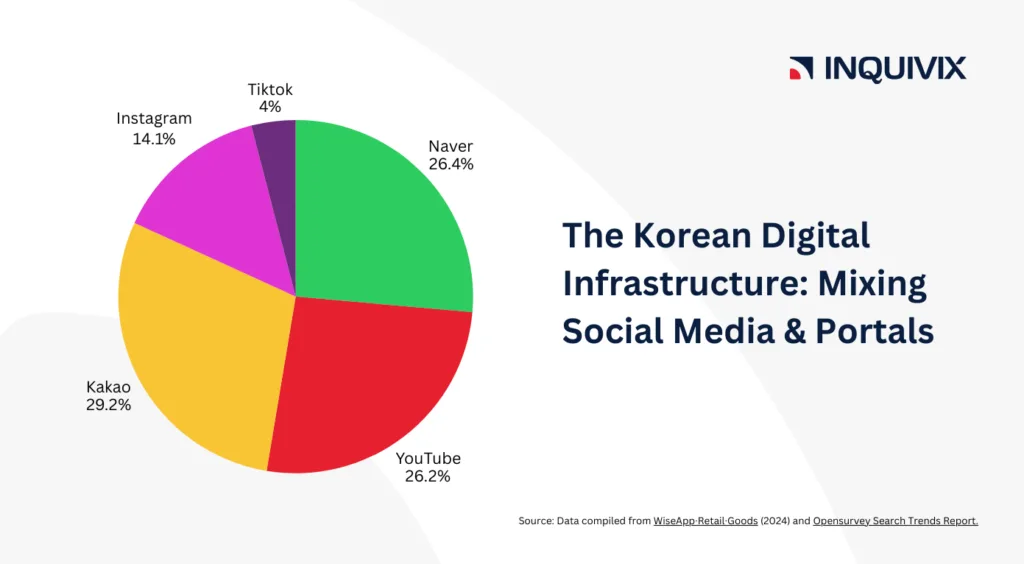
Source: Data compiled from WiseApp·Retail·Goods (2024) and Opensurvey Search Trends Report.
- Global Platforms (Instagram, YouTube, and TikTok): These are essential for reaching the 20 to 30 age demographic and international tourists. High-quality visual content builds the identity of the café. These platforms create the “vibe” that motivates a user to save a location for a future visit.
- Local Infrastructure (Naver Smart Place and KakaoMap): These are the final decision-making tools. A consumer may discover a café on TikTok, but they will check Naver Receipt Reviews to verify the actual experience before visiting. If the local map profile is poorly managed, the interest generated on social media will not convert into a physical visit.
The Role of Global Platforms
Instagram, YouTube, and TikTok act as the digital storefront for your business. In the South Korean market, a cafe’s visual appeal is often just as important as the quality of its coffee.
- Instagram (The Visual Hook): This is the primary tool for brand discovery. High-quality photos and Reels allow a cafe to stand out in a crowded market. Users often browse “cafe-gram” hashtags to find their next weekend destination based on interior design and food presentation.
- YouTube (The Atmosphere Builder): YouTube is essential for “vibe verification.” Potential customers watch cafe vlogs or cinematic reviews to experience the full scale, noise level, and “mood” of a location before they visit. It builds a deeper level of trust and familiarity than a single photo can.
- TikTok (The Viral Spark): This platform is used for trend participation. By using trending Korean audio or unique “behind-the-scenes” clips, a cafe can quickly reach a massive organic audience. This is particularly effective for launching limited-edition menus or showcasing unique service styles.
The Role of Local Infrastructure
Naver and Kakao are the primary tools for navigation and intent-based search.
- Trust and Verification: Naver Smart Place serves as a verified record of business hours, menus, and genuine customer feedback. For a foreign-owned franchise, maintaining an accurate and active Naver profile is the most effective way to build trust with local consumers.
- Navigational Conversion: Because KakaoMap and Naver Map are the dominant GPS tools in Korea, appearing in the top results for local searches is the most direct way to capture nearby foot traffic.
Strategic Solutions: Managing Capital and Visibility
Thriving in the 2026 Korean F&B market requires moving beyond a “launch and wait” mindset. Long-term success depends on a two-pronged strategy: securing enough capital to bridge the 24-month survival gap and maintaining a consistent “digital rent” budget to ensure steady foot traffic.
Capital Management: Bridging the ROI Gap
Since the average time to recover an initial investment is now 24 to 31 months, financial planning must extend far beyond setup costs.
- The 36-Month Runway: Securing enough working capital to cover at least three years of fixed costs, including rent and labor, is essential. This prevents a cash shortage during the second year when the initial “opening hype” typically fades. Data from the National Tax Service indicates that businesses reaching the three-year mark have a significantly higher probability of long-term stability.
- Accounting for Mandatory Increases: Projections should include a 5–10% annual increase in operational costs. This baseline accounts for mandatory minimum wage hikes that set by the Minimum Wage Commission, and scheduled rent adjustments.
- Margin Protection: Negotiating for lower shared marketing fees or flexibility in sourcing non-core materials, such as packaging or basic supplies, helps protect the net profit margin.
Visibility Management: The Digital Utility Model
Marketing functions as a fixed operational cost, similar to electricity or water. Discontinuing visibility spend effectively removes the business from the local market.
- The 7% Allocation Rule: Setting aside approximately 7% of monthly gross revenue as a fixed marketing cost ensures consistent search rankings. This allocation remains separate from national branding fees paid to a franchise headquarters.
- Direct Naver Place Optimization: Success begins with owner-managed registration. Since many of the local restaurants fail to properly maintain their listings, proactive management provides a significant competitive advantage. Prioritizing keyword-optimized descriptions and high-quality photos of the interior, exterior, and menu is essential for organic growth and helps stabilize the overall marketing cost.
- Keyword Structuring: Analyzing top-ranked competitors to benchmark category relevance and keyword accuracy allows a business to drive exposure without immediate reliance on paid ads. This approach utilizes Naver’s official big data tools to refine search combinations.
- Verified Local SEO: Allocating the budget on Naver Smart Place ads and securing Receipt Reviews yields the highest conversion rates. These reviews represent verified customer satisfaction, which serves as the primary standard for Korean consumers.
- Neighborhood-Specific Partnerships: Partnering with local influencers or “cafe-grammers” who specialize in specific districts, such as Mapo-gu or Gangnam, drives high-intent traffic from nearby residents.
Inquivix Advantage: Cross-Platform Performance
Navigating the complexities of the South Korean café market requires more than creative content. It demands a deep understanding of local digital infrastructure and consumer psychology. Inquivix provides the strategic expertise necessary to manage “digital rent” and secure long-term profitability for foreign investors and local operators alike.
Bridging the Gap with Data-Driven Growth
With the average ROI for Korean café franchises extending to 24 to 31 months, marketing must focus on financial sustainability.
- Capital Protection: By optimizing marketing spend to target high-intent local traffic, the risk of a cash shortage during the critical second year is minimized.
- Performance Benchmarking: Inquivix leverages data-driven insights to align marketing KPIs with actual store traffic and revenue.
- Strategic Scaling: Performance is tracked continuously to ensure that as sales plateau, marketing efforts adapt to find new audience segments or increase the frequency of visits from existing customers.
Holistic Ecosystem Management
Inquivix bridges the gap between global discovery and local conversion through a unified omnichannel approach. This strategy ensures that a café remains visible across all five critical platforms.
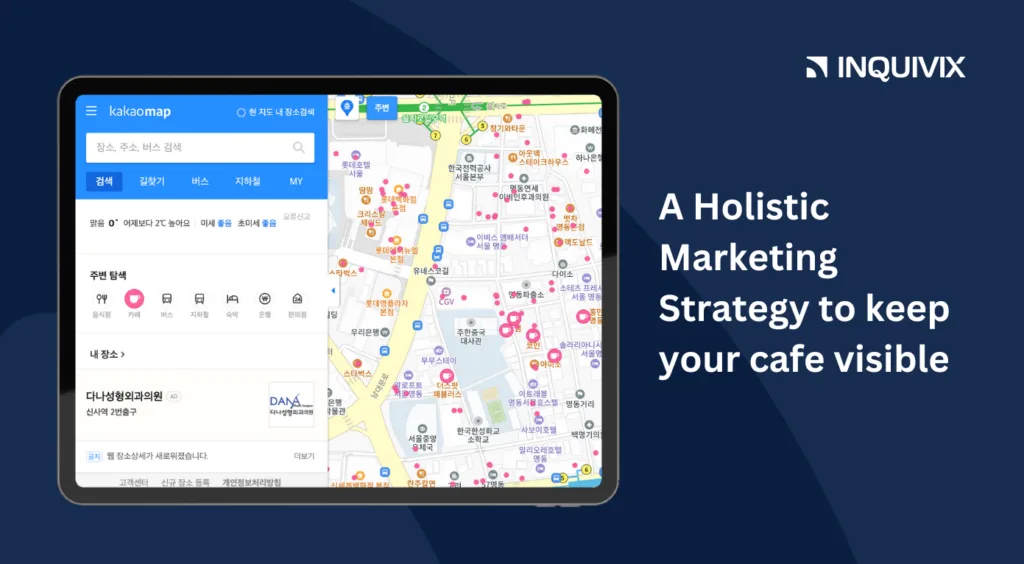
- Localized SEO and Maps: Expert management of Naver Smart Place and KakaoMap ensures that a café is easy to find and verify. This includes the strategic acquisition of Receipt Reviews to build trust.
- Aesthetic and Viral Content: Professional production for Instagram Reels, TikTok, and YouTube captures the visual-first nature of the Korean market, ensuring a café stands out in a saturated environment.
- Retention Systems: Developing KakaoTalk Channel strategies allows businesses to turn one-time visitors into loyal regulars, protecting the business from the high costs of constantly acquiring new customers.
The Inquivix strategy ensures that every marketing dollar contributes to a seamless customer journey, moving from the first digital impression to the final physical transaction. By treating marketing cost as a fixed utility rather than an optional expense, businesses can stabilize their cash flow and survive the 24-month pivot point.
Achieving Long-Term Financial Viability
Entering the South Korean café market in 2026 requires a shift in perspective. Success no longer depends solely on a high-quality product or a trendy interior. Instead, it relies on a disciplined financial approach and a sophisticated digital strategy that accounts for the unique infrastructure of the Korean internet.
The Path Forward
Long-term profitability is achievable for operators who prioritize data over guesswork. By securing a 36-month capital runway and maintaining a consistent 7% marketing allocation, businesses can navigate the “Sales Plateau” and build a loyal customer base.
The Korean F&B landscape remains one of the most dynamic in the world. Investors who respect the local cost structures and digital habits will find a market that rewards consistency, aesthetic excellence, and technological integration.