Why Foreign Restaurant Brands Struggle in Korea Even When the Food Is Good
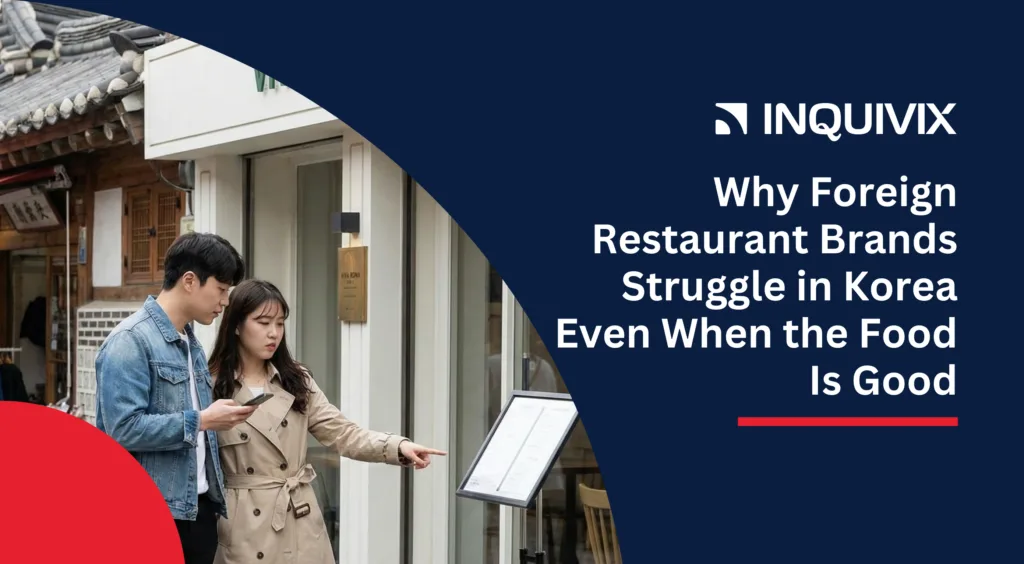
The South Korean Food and Beverage (F&B) market presents a specific paradox: foreign restaurant brands struggle in Korea even with their high product quality and international prestige frequently fail to sustain operations beyond the initial three-year mark. While these brands often enter the market with significant social media engagement, many exit within a 24 to 36-month window. This failure rate is not typically a result of poor product quality, but rather a fundamental misunderstanding of the local competitive landscape.
In the Korean market, high-quality taste is a baseline entry requirement rather than a sustainable competitive advantage. Consumers expect premium quality as a standard; therefore, a superior menu alone does not provide sufficient differentiation to ensure long-term survival. Data from the National Tax Service and the Fair Trade Commission indicate that the survival rate for new F&B businesses drops significantly after the second year.
The primary driver of this trend is the visibility gap. While a foreign brand may possess an excellent product, it remains functionally invisible to the domestic audience if it is not integrated into the local digital infrastructure. Success in Korea is determined by the transition from “product discovery” to “digital verification.” Without a localized strategy to manage this transition, even the most reputable foreign restaurant brands in Korea struggle to achieve the necessary return on investment (ROI) within the critical first three years.
Structural Realities of the Saturated Korean F&B Market
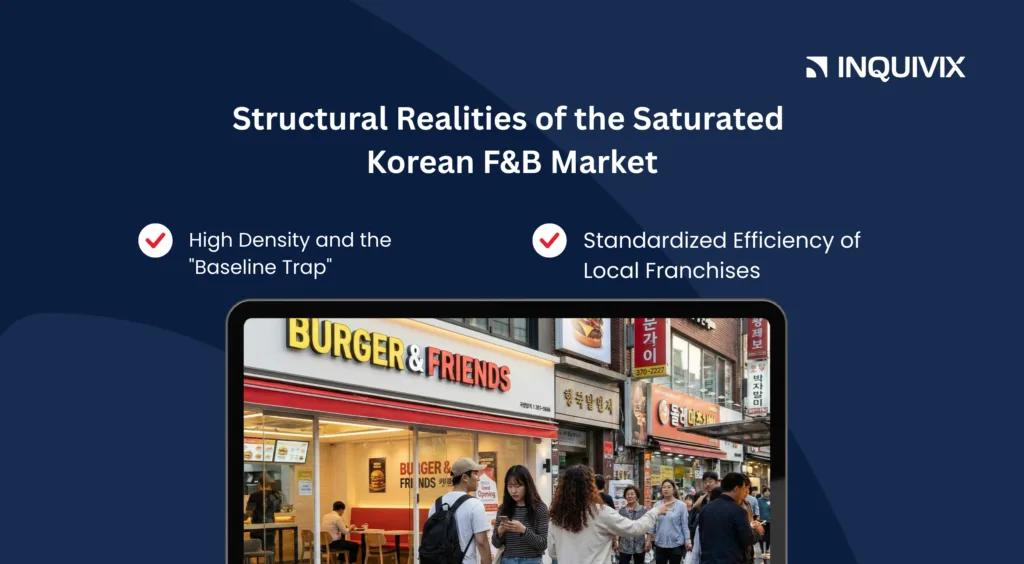
The South Korean F&B sector is defined by extreme density and high operational efficiency. According to the National Tax Service (NTS), South Korea maintains one of the highest restaurant-per-capita ratios globally, with approximately one restaurant for every 72 citizens. This saturation creates a market environment where consumer choices are abundant, and the cost of switching between brands is nearly zero.
High Density and the “Baseline Trap”
In a market with over 800,000 F&B establishments, “good food” serves only as a basic requirement for entry. Failure among foreign restaurant brands in Korea often stems from the “Baseline Trap”, which is the assumption that product excellence will naturally overcome a lack of visibility. In high-density districts like Gangnam, Hongdae, or Hannam-dong, hundreds of high-quality options are available within a 500-meter radius. If a brand does not appear in the top results of local discovery tools, it is excluded from the consumer’s decision-making process regardless of its culinary quality.
Standardized Efficiency of Local Franchises
Domestic Korean franchises operate with a level of standardized efficiency that foreign operators often struggle to replicate initially. Local brands utilize:
- Optimized Supply Chains: Direct integration with local agricultural and logistics networks to maintain low food costs.
- Digital Integration: Immediate synchronization with delivery platforms (Baemin, Coupang Eats) and reservation systems (CatchTable).
- Labor Efficiency: Heavy reliance on automated kiosk systems and standardized cooking processes to manage the 2026 minimum wage requirements.
Foreign brands that enter without these localized efficiencies often face higher overhead costs and slower service speeds, leading to a decline in consumer behavior in the Korean F&B industry metrics such as “wait-time satisfaction” and “price-to-value” perception on local review platforms.
The Verification Gap: Consumer Behavior in the Korean F&B Industry
In the consumer behavior in the Korean F&B industry, there is a clear difference between seeing a restaurant and deciding to visit it. Many foreign restaurant brands in Korea fail because they do not understand that Korean consumers do not trust social media alone.
How Consumers Choose a Restaurant
Korean consumers use a specific three-step process to decide where to eat. If a brand is missing from any of these steps, it loses the customer:
- Discovery (Instagram/TikTok): Users see an attractive photo or video. This creates interest, but it is not enough to make them visit.
- Verification (Naver): This is the most important step. Users search the restaurant on Naver to find “Receipt Reviews.” These are reviews written by people who have actually paid for a meal at that location.
- Navigation (KakaoMap/Naver Map): Users check the map to see the exact location, business hours, and the easiest way to get there.
The Problem of Low Visibility
Even if the food is excellent, it is “invisible” if it lacks proof on local platforms. Korean diners avoid restaurants that do not have recent reviews because they see it as a risk to their time and money. According to data from Opensurvey, consumers use different platforms for different goals:
- Instagram and YouTube are used to find new ideas.
- Naver is used to check if the restaurant is actually good and trustworthy.
Trust as a Requirement
For a foreign brand, “platform trust” is more important than the brand name itself. Research shows that local portals like Naver and Kakao are the primary tools for final decision-making in Korea. If a restaurant has high social media engagement but low Naver search results, it creates a “Verification Gap.” This gap prevents interested people from turning into actual customers who walk through the door.
Cultural and Product Localization Errors in Foreign Restaurants
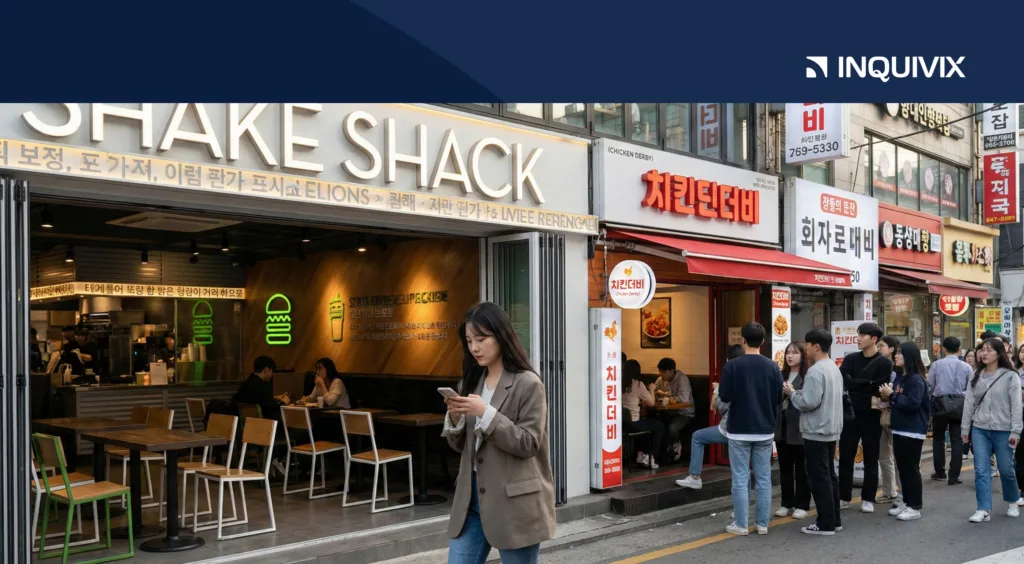
One major reason why foreign restaurants fail in Korea is the refusal to adapt to local dining expectations. While global brands prioritize “authenticity,” they often miss the specific cultural and health requirements that drive consumer behavior in the Korean F&B industry.
Taste Profiling and the “Danjjan” Preference
Foreign recipes often use salt levels that Korean consumers find too high. The Korean consumers prefer a balance called “Danjjan,” which is a specific mix of sweet and savory flavors.
- Saltiness: Authentic Western dishes are often described as “too salty” in local Naver reviews, which lowers the overall rating of the restaurant.
- Sweetness: Successful localized brands often add a slight sweetness to savory dishes to match local expectations for the Danjjan profile.
- Texture: Research from Trend Monitor (Embrain) shows that Korean diners value specific textures, such as “jjolgit” (chewy) or “basak” (crispy). If a Western brand does not adjust the texture of its products, like bread or meat, consumers may view the quality as poor.
Dining Habits: Individual Plates vs. Sharing Culture
In Western dining, it is common for each person to eat from their own separate plate. However, Korean dining culture often centers on sharing multiple dishes placed at the center of the table.
- Group Dining: While more individuals are eating alone, group dining remains a primary source of income for most restaurants.
- Menu Structure: Establishments that only offer individual portions without “sharing” options often lose business from families and corporate groups. Data from Opensurvey indicates that the ability to share multiple menu items is a key factor when groups choose a dining location.
Seasonal Adaptation and Trend Speed
Korean food trends move faster than almost any other market. Failing to rotate the menu creates a “stagnant” brand image.
- Rapid Menu Rotation: Local competitors are aggressive with limited-time offers, such as strawberry-themed menus in the spring or spicy-themed menus in the winter. Western brands that keep a static, unchanging menu often lose the interest of the local audience. To stay competitive, brands must align with seasonal produce. Since 2024, Korean consumers have now prioritized seasonal food and vegetarian categories as part of a healthy lifestyle.
- Ingredient Sourcing: Trust is built through transparency. The current trend shows a strong preference for domestic (Korean) raw materials. Brands that fail to certify their ingredient sources or ignore the demand for healthy, domestic produce struggle to pass the consumer’s “Verification” phase.
- Hygiene as a Trust Marker: Beyond the food itself, store hygiene certification is now a critical decision factor. Consumers use digital platforms to verify a restaurant’s hygiene rating before visiting, making physical and digital transparency a mandatory operational requirement.
Operational Friction and Technical Barriers to Entry
Operational friction refers to the technical difficulties that prevent a customer from completing a purchase. In the Korean market, where consumer convenience is prioritized, even minor technical barriers can cause a restaurant to lose significant business. Foreign brands often fail because they rely on global systems that do not align with the local digital infrastructure.
Kiosk and Localized Payment Systems
South Korea has one of the highest rates of automated kiosk usage in the world, largely driven by high labor costs and the 2026 minimum wage standards. However, foreign operators frequently implement systems that alienate local users.
- Payment Infrastructure: While international brands often prioritize Visa or Mastercard, domestic consumers primarily use KakaoPay, Naver Pay, and Toss. A system that does not support these methods instantly creates a barrier at the final stage of the transaction.
- User Interface (UI) and Language: Many foreign brands use kiosks with English-only menus or layouts that do not follow the standard Korean ordering logic. This makes the restaurant feel inaccessible to the local population, who represent the largest segment of the market.
Platform Exclusion: The “Super-App” Ecosystem
In Korea, a restaurant’s existence is tied to its presence on local “super-apps.” Failure to integrate with these platforms is a primary reason why foreign restaurants fail in Korea.
- Delivery Integration: Platforms like Baemin (Baedal Minjok) and Coupang Eats dominate the market. Foreign brands that attempt to use their own independent delivery apps or skip these platforms entirely lose access to the majority of “at-home” and “at-office” diners.
- Reservation and Queue Management: The standard for table management is CatchTable or Naver Booking. Consumers expect to verify wait times and book tables through these apps. If a restaurant requires a phone call or a physical visit to join a queue, consumers will typically choose a competitor with digital integration.
The Cost of Technical Friction
Technical friction increases the cost of acquiring a customer. When a potential diner faces difficulty navigating a non-localized website, a QR code that leads to a slow global server, or an English-only PDF menu, the “mental effort” required to dine at the restaurant increases. In a saturated market with abundant alternatives, consumers rarely choose the high-friction option. To succeed, a foreign brand must ensure its digital and physical operations are as seamless as those of a local franchise.
Competitive Displacement: How Local Brands Hijack Foreign Traffic
Even if a foreign brand achieves high awareness, it faces the risk of competitive displacement. In the Korean F&B market, local competitors are highly skilled at “hijacking” the traffic generated by global brands through platform-specific tactics. This often explains why foreign restaurants fail in Korea despite having strong initial social media interest.
Keyword Hijacking on Naver Search
Local franchises and independent operators often bid on the brand names of popular foreign restaurant brands in Korea through Naver Power Link ads.
- The Bait-and-Switch: When a user searches for a specific foreign brand to verify its location, the top search results are often advertisements for local competitors offering similar menu items with “better value” or “localized taste.”
- Transliteration Gaps: Local brands often optimize for every possible Korean spelling (transliteration) of a foreign brand’s name, ensuring they appear in the search results even when the foreign brand’s official page does not.
Proximity Hijacking on Naver and KakaoMap
The consumer behavior in the Korean F&B industry is heavily reliant on “Map Discovery.” Local competitors use this to their advantage through proximity-based marketing.
- The “Alternative Choice” Placement: On Naver SmartPlace, local restaurants frequently appear in the “People Also Looked At” or “Nearby Recommendations” sections of a foreign brand’s profile.
- Review Density: Local competitors often have a higher volume of Naver Receipt Reviews. When a consumer compares a foreign brand (with 50 reviews) to a local competitor (with 500 reviews) located 10 meters away, the “trust factor” usually leads them to the local option.
Rapid Concept Adaptation
Korea is famous for the speed at which it replicates global trends.
- Rapid Replication: If a foreign brand introduces a unique concept (e.g., a specific style of New York bagel or London-style café), local operators can launch a “localized version” within weeks.
- Superior UI/UX: These local “clones” are often better integrated with KakaoPay, Baemin, and CatchTable from day one, providing a lower-friction experience that “steals” the hype from the original foreign brand.
The Strategic Framework: Restaurant Marketing in Korea for Foreigners
Understanding how to market a restaurant in Korea as a foreigner requires moving beyond global social media tactics and embracing the local “Super-App” ecosystem. To bridge the visibility gap and overcome these unique market barriers, operators must implement a tactical framework that prioritizes local digital infrastructure over global branding. In Korea, being “famous on Instagram” is only the first step; being “verified on Naver” is what actually fills the seats.
Naver SmartPlace: The Foundation of Digital Credibility
Naver SmartPlace is the most critical asset for any restaurant in Korea. It serves as your official digital “home base” where consumers find your menu, hours, and location.
- Owner-Managed Registration: Secure algorithmic favor by registering as a verified business owner. This allows you to update “live” information and respond directly to customer inquiries.
- Naver Receipt Reviews: Korean consumers prioritize “Receipt Reviews” because they prove the reviewer actually paid for a meal. Building a high volume of these reviews bridges the “verification gap” and establishes immediate trust with new customers.
KakaoMap: Enhancing Local Accessibility and Navigation
While Naver is for searching, KakaoMap is often the preferred tool for active navigation and real-time discovery.
- Navigation Accuracy: Ensure your “Map Pin” is precise and your business data is synchronized across the Kakao ecosystem. High-intent users often search for “restaurants near me” directly inside the KakaoMap app.
- User-Generated Tags: Encourage visitors to tag your location on Kakao. This increases your visibility in the “trending places” section of the map, capturing foot traffic from nearby competitors.
Local SEO and Visibility Engineering
Generic keywords like “best burger” are too competitive for most new brands. Instead, success comes from District-Level Keyword Optimization.
- Neighborhood Targeting: Use Naver’s big data tools to identify specific search terms used in your district (e.g., “Best Seongsu-dong Date Spot” or “Hannam-dong Lunch Specials”).
- Search Intent Alignment: Structure your business description to satisfy local search logic. By including landmarks or specific neighborhood names in your profile, you secure organic rankings in high-density districts.
The Dual-Track Content Strategy: Influencers vs. Bloggers
A common mistake is focusing only on Instagram. To succeed, you must manage two different types of content:
- Instagram/TikTok (Discovery): Use visual “eye-catchy” to create initial interest. This is the “top of the funnel” where people discover your brand.
- Naver Blogs (Verification): When a user sees your food on Instagram, they will search for a Naver Blog to see a detailed, step-by-step review. Blogs provide the “social proof” and detailed photos (like the entrance, the restroom, and the side dishes) that consumers require before they commit to a visit.
Strategic Paid Visibility: Maximizing Smart Place Ads
Organic reach alone is rarely enough in a saturated market. We recommend the 7% Marketing Cost Rule: allocating 7% of your projected revenue to local advertising.
- Smart Place Ads: These ads place your restaurant at the very top of Naver Map search results. Unlike standard banners, these target people who are already looking for a place to eat in your specific neighborhood.
- Peak Hour Spending: Focus your ad budget on high-intent windows, specifically 11:00 AM for lunch and 5:00 PM for dinner, to outpace domestic competitors who rely solely on organic traffic.
Navigating the Korean F&B Landscape with Inquivix
Knowing the structural challenges of the Korean market is only the first step. For foreign restaurant brands in Korea, the actual challenge lies in execution. Inquivix provides a tactical bridge between global brand standards and the technical requirements of the Korean digital ecosystem, ensuring that “good food” actually results in a sustainable business.
Technical Localization and Infrastructure Setup
Most foreign restaurants fail in Korea not because of their product, but because they are “digitally locked out” of the local market. Inquivix solves this by managing the entire technical setup:
- Naver & Kakao Ownership: We handle the complex verification and registration process for Naver SmartPlace and KakaoMap, ensuring your business is correctly categorized for the local search algorithm.
- Payment & Kiosk Integration: We consult on localizing your in-store technology, from kiosk UI/UX in Korean to ensuring your POS system supports domestic “Pay” services (Naver/Kakao/Toss).
Data-Driven “Taste and Trend” Intelligence
Inquivix utilizes local market data to advise brands on necessary adjustments.
- Menu Engineering: We help brands adapt their menu descriptions and flavor profiles (like salt and sweetness levels) to match the “Danjjan” preference without losing their brand identity.
- Trend Monitoring: Because the Korean market moves rapidly, we provide ongoing intelligence on seasonal shifts and competitor “Rapid Concept Adaptation,” allowing your brand to react before losing market share.
Managing the “Discovery-to-Verification” Funnel
We eliminate the “Visibility Gap” by managing a dual-track content strategy that aligns with consumer behavior in the Korean F&B industry.
- Discovery (Social Media): We manage high-visual content on Instagram and TikTok to generate the initial “buzz.”
- Verification (Naver Bloggers): We deploy a network of verified Naver Bloggers to create the detailed, searchable “social proof” that Korean consumers require to make a final visit decision. This ensures that a “Like” on social media actually turns into a table reservation.
Precision Performance Marketing (The 7% Rule)
We remove the guesswork from marketing budgets. By applying the 7% marketing cost rule, we ensure that your ad spend is never wasted on broad, generic audiences.
- Hyper-Local Targeting: We manage Naver Smart Place ads and PowerLink ads that target consumers exactly when they are searching in your specific district (e.g., Gangnam, Seongsu, or Hannam).
- ROI-Focused Spending: We optimize your budget to focus on “Peak Intent” hours, ensuring you dominate the map results during the most profitable dining windows.
How Foreign Brands Can Actually Win in Korea
Winning in the Korean F&B market requires a complete shift in mindset. Many foreign restaurant brands in Korea fail because they treat the market like a global extension of their home brand. To succeed, you must accept that in Korea, your culinary reputation is secondary to your digital credibility.
The Three Pillars of Long-Term Success
To move past the dangerous 24–36 month failure window, brands must focus on three core pillars:
- Verification over Discovery: While Instagram creates the initial interest, Naver and KakaoMap finalize the sale. You must ensure that when a consumer searches for your brand, they find a high volume of recent “Receipt Reviews” and detailed blog posts. Without this, your social media “hype” will never turn into foot traffic.
- Infrastructure over Identity: A brand that cannot accept KakaoPay, does not use local delivery apps like Baemin, or lacks a localized kiosk interface will always face a “technical ceiling.” Success requires integrating into the local digital ecosystem so that the buying process is invisible and effortless for the customer.
- Agility over Authenticity: “Authentic” food that is too salty or lacks a seasonal rotation will struggle to find repeat customers. Use data from sources like Opensurvey to monitor shifts in health consciousness and trend preferences. The ability to adapt your menu while keeping your core brand “vibe” is what separates a short-term trend from a long-term institution.
Final Takeaway: Don’t Go It Alone
The visibility barrier in Korea is a structural problem, not a product problem. Even the best-tasting food can fail if it remains functionally invisible to the local search engines. By prioritizing localized digital infrastructure and professional platform management, foreign brands can transform from “new and interesting” to “verified and essential.”