How Long Trends Actually Last in Korea (And How to Avoid Entering Too Late)
The South Korean consumer market operates as a high pressure laboratory for global trends, characterized by a level of volatility and velocity that is rarely seen in other major economies. For international brands and market entrants, the fundamental challenge lies in distinguishing between a fleeting viral fad and a sustainable market shift.
This environment is driven by a unique convergence of historical urgency, world leading digital infrastructure, and a collective social psychology that prioritizes rapid adoption. The advertising market in South Korea reached a valuation of 12.9 billion USD in 2024 and is projected to expand to 22.9 billion USD by 2033, exhibiting a compound annual growth rate (CAGR) of 5.93%.
This expansion is not merely a product of increased spending but a reflection of a market that is fundamentally reinventing itself through artificial intelligence, localized digital campaigns, and a profound shift in consumer values as we move toward 2026.
Understanding the lifecycle of these trends is no longer just a competitive advantage but a prerequisite for survival in a landscape where a product can transition from a national obsession to market saturation within a single season. If you are planning your market entry in South Korea, understanding this velocity is the first step toward success.
The Cultural Foundation of the Korean Velocity
To understand the speed of how long trends actually last in Korea, one must look at the historical and cultural concept of pali pali, which translates to hurry hurry. This mindset is deeply embedded in the Korean work culture and daily life, serving as the primary driver behind the nation’s rapid progress and efficiency. The origin of this cultural phenomenon can be traced back to the period of rapid industrialization following the Korean War. To recover from economic devastation and transform into a global powerhouse, South Korea adopted a work ethic centered on speed and productivity.
This urgency became a defining feature of the society, influencing everything from business operations to public transportation and social interactions. In the modern era, this translates into a consumer base that displays minimal tolerance for delays and an insatiable appetite for the latest innovations. This is why partnering with Inquivix is essential for foreign brands to keep up with the local pace.
The impact of this mindset is visible in the physical and digital infrastructure of the country. For example, Seoul’s subway and bus systems operate with incredible efficiency, where commuters often run up escalators and stand to disembark even before a bus comes to a complete stop. In the digital realm, this has led to the development of the world’s fastest internet and a logistics sector where one day and same day delivery are the standard expectations. This infrastructure allows information and products to spread across the entire country almost simultaneously, creating an environment where trends can ignite and reach a fever pitch overnight.
| Feature of Pali Pali Culture | Impact on Consumer Behavior |
| National Urgency | High demand for immediate results and instant gratification. |
| Efficiency Focus | Preference for streamlined, frictionless shopping experiences. |
| Rapid Adoption | Willingness to try new technologies and products ahead of global curves. |
| Competitive Social Environment | Tendency to follow collective trends to maintain social relevance. |
This cultural foundation is further amplified by the high density of the urban population and the country’s advanced digital infrastructure. With over 95% smartphone penetration and 98% of households having internet access, Koreans are among the most tech savvy and highly connected consumers globally. This connectivity ensures that any viral moment, whether it is a new food item or a fashion accessory, is shared and validated across massive social networks in real time.
Quantitative Lifecycle Analysis of Viral Trends
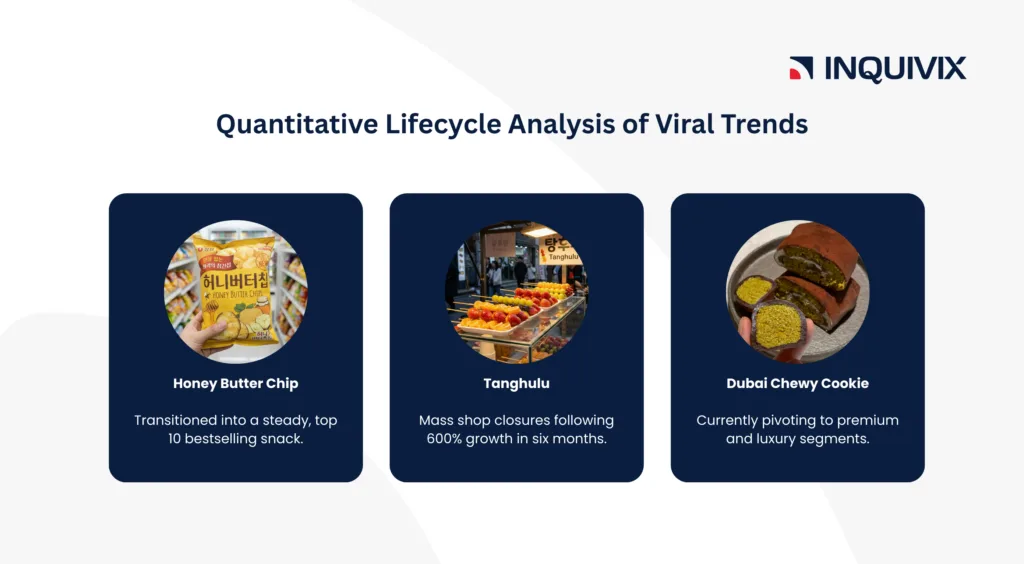
The lifespan of a trend in Korea is often significantly shorter than the global average, though the specific duration varies depending on the industry and the barrier to entry. Historical data from viral food crazes provides a clear template for understanding these cycles. Trends generally follow an arc that includes social media amplification, a peak driven by scarcity and the fear of missing out, and a subsequent decline triggered by hyper saturation or shifting consumer concerns.
Case Studies in Trend Lifespans
The following table compares three major trend archetypes observed in the Korean market, illustrating how barrier to entry and market saturation influence the duration of relevance.
| Trend Archetype | Product Example | Peak Duration | Market Outcome |
| Sustainable Integration | Honey Butter Chip | 18 Months | Transitioned into a steady, top 10 bestselling snack. |
| Rapid Saturation | Tanghulu | 8 Months | Mass shop closures following 600% growth in six months. |
| Maturity Stress Test | Dubai Chewy Cookie | 5 Months | Currently pivoting to premium and luxury segments. |
The Honey Butter Chip phenomenon, which began in late 2014, represents a trend with a high barrier to entry due to its manufacturing requirements. The production shortages, which some viewed as a strategic marketing tactic, fueled demand and extended the trend’s lifespan to roughly 18 months before it stabilized as a standard snack option.
In contrast, Tanghulu, a Chinese street dessert, experienced a much shorter cycle because of its low barrier to entry. The ease with which street stalls could be established led to a hyper saturation of the market, with the number of shops expanding from 50 to 300 nationwide within just five months. This oversupply, combined with growing health concerns over sugar content, led to a rapid market collapse in late 2024.
The Dubai Chewy Cookie, or Dujjonku, represents the 2025 to 2026 trend cycle. It is currently facing a maturity stress test as it encounters supply chain friction regarding pistachio costs and a growing health trend toward zero sugar options. For businesses, the lesson is that scarcity creates value while oversaturation destroys it. Entering a trend when it has already reached hyper saturation often results in significant financial loss, particularly for entrepreneurs and food service investors who scale too rapidly based on viral momentum.
The 2026 Consumer Forecast: Horse Power and Beyond
As we move into 2026, the Korean market is undergoing a fundamental reorganization driven by full scale artificial intelligence transformation and a shift toward emotional and ethical consumption. The 2026 edition of Trend Korea, led by Professor Kim Nan-do, identifies Horse Power as the overarching keyword for the year, symbolizing the endurance and agility needed to navigate these shifts. This forecast highlights 10 key themes that will shape consumer life in the AI era.
Human in the Loop and Emotional Value
One of the most significant shifts is the concept of Human in the Loop, which emphasizes that as AI becomes more embedded in daily life, human judgment and expertise become more essential. This trend reflects a philosophical principle that at least one human intervention is necessary for ethics and personal values in decision making. Alongside this is the Feelconomy, where spending is increasingly driven by emotion. Consumers are more likely to invest in products that bring comfort, reduce stress, or spark joy, such as fandom goods and personalized experiences.
The Logistics of the Zero Click Economy
The Zero Click trend describes a world where AI recommendations become so accurate that consumers no longer need to actively search for products. Systems anticipate needs before a user acts, suggesting what to eat, buy, or book. This creates a lifestyle where algorithms handle routine tasks, allowing humans to focus on meaning and emotional satisfaction. For marketers, this means that visibility within AI recommendation engines is becoming more critical than traditional search visibility.
| Theme | Keyword | Core Concept |
| H | Human-in-the-Loop | Human judgment remains the final decision maker in AI systems. |
| O | Oh, my feelings! | The rise of the Feelconomy, where mood drives consumption. |
| R | Results on Demand | Zero Click experiences where systems anticipate consumer needs. |
| S | Self-directed Readiness | Ready-Core lifestyles where people prepare for global uncertainty. |
| E | Efficient Organizations | AI transformation breaking down rigid workplace hierarchies. |
| P | Pixelated Life | Life unfolding in small digital squares like screens and virtual spaces. |
| O | Observant Consumers | Price Decoding, where buyers analyze price as a transparent code. |
| W | Widen Health IQ | AI driven insights shifting health management to personalized wellness. |
| E | Everyone is an Island | The 1.5 household, a hybrid between solo and shared living. |
| R | Return to Fundamentals | A thirst for authenticity, traditional craftsmanship, and true value. |
These themes suggest a Korea that is increasingly analytical about price and quality while simultaneously craving authentic, non exaggerated branding. The concept of Price Decoding is particularly relevant as consumers demand transparent value and clear justification for premium pricing, especially in an era of inflation and market uncertainty. Brands must ensure their Korean e-commerce payment methods are transparent and efficient to meet these demands.
Digital Infrastructure and Native Platform Evolution
To reach the Korean consumer effectively, brands must master the local digital landscape, which is dominated by Naver and Kakao. These platforms are not merely search engines or messaging apps but entire ecosystems that manage shopping, payments, and social interactions.
Naver: The Evolution Toward Omni-modal Search
Naver remains the number one search engine in Korea, dominating 59% of the local market. However, the way users interact with Naver is changing. Exploratory searches, where users look for a variety of information rather than a single answer, now account for 70% of queries. To meet this demand, Naver is introducing Omni-modal AI technology. This system, such as HyperCLOVA X SEED 8B Omni, integrates text, images, and audio into a single model, allowing the AI to understand complex contexts and solve problems across different environments.
For advertisers, this means that search engine optimization must be more sophisticated. Success on Naver requires a multi-layered approach that includes brand blog management, cafe marketing, and Q&A optimization on platforms like Jisikin, which is the Korean equivalent of Quora.
Kakao: AI Driven Advertising and Engagement
Kakao has introduced Moment AI, a service designed to optimize advertising efficiency through AI based analysis. This service analyzes user journeys and identifies drop off points, providing advertisers with optimization scores and specific actionable suggestions. By leveraging Kakao Talk’s massive user base, which has over 122% mobile connection compared to the population, brands can run performance driven campaigns that are highly targeted.
| Platform | Key 2026 Feature | Strategic Benefit |
| Naver | Omni-modal HyperCLOVA X | Contextual understanding of vague or complex search queries. |
| Kakao | Moment AI & CAPI | Automated ad optimization and server side conversion tracking. |
| Danggeun | Hyperlocal Cafe Function | Community based targeting for shared local interests. |
| Apple | App Store Search Expansion | Increased visibility for app discovery through the entire search page. |
The introduction of the Conversion API (CAPI) on Kakao is particularly significant for 2026. It allows advertisers to send conversion information directly from their own servers to Kakao, providing more accurate performance measurement and better ad optimization while adhering to stricter privacy regulations.
The Growth of Sleepmaxxing and Health Intelligence
A major trend that has emerged among the MZ generation is Sleepmaxxing, which involves optimizing sleep quality and duration to support mental well being. This trend is a reaction to the traditionally high stress, sleep deprived culture of Korea. It is driving a surge in the sleep tech market, which is expected to grow at a CAGR of 14.1% between 2025 and 2033.
Consumers are increasingly turning to AI and IoT technologies to create the perfect sleep environment. Smart mattresses that analyze body pressure and adjust hardness, AI motion pillows that detect snoring and adjust head position, and wearable devices that track REM cycles are all gaining traction. Nearly 18% of adults in South Korea experience chronic insomnia, and 70% of the population reportedly prioritizes wellness in their lifestyle choices.
| Sleep Tech Innovation | Brand Example | Functional Benefit |
| Smart Mattress | LG Electronics / Coway | Real time temperature and pressure adjustment via IoT. |
| AI Motion Pillow | 10Minds | 에어백 system that adjusts posture to stop snoring. |
| Brainwave Sensing | LG Brid.zzz | Real time EEG measurement to provide sleep inducing sounds. |
| Personalized Bedding | Evezari M.A.X.X | Hyper personalized bedding solutions based on sleep data. |
The market for sleep tracking devices is projected to reach over 1,516 million USD by 2030, highlighting the massive opportunity for brands in the health and wellness sector to offer data driven, personalized solutions.
Cross Industry Collaboration and Branded Content
In a market where consumers are highly skeptical of traditional advertising, cross industry collaboration and high quality branded content are becoming essential. These strategies allow brands to refresh their image and reach new demographics in an authentic way.
The Rise of Ijong (Cross-Industry) Marketing
Several major corporations have recently engaged in collaborations that blend high tech with everyday consumer goods. SK Hynix partnered with Seven-Eleven to launch HBM Chips, where the acronym for high bandwidth memory was cleverly used to brand a snack. Kia Motors collaborated with Musinsa to open a pop-up store for the EV4, using fashion photography to emphasize the vehicle’s unique design to a younger, trend conscious audience.
Branded Content and Storytelling
The project The Christmas Song, a collaboration between Google’s Gemini AI and the production company Dolgorae Jumaengdan, demonstrates the power of high quality storytelling. Despite being a 22 minute long video, it achieved high engagement because it focused on how AI can extend human emotion and creativity rather than just displaying technical features.
Similarly, the collaboration between Disney’s film Wish and the K-pop idol An Yujin of the group IVE showed how fan driven consumption can be used as an effective branding strategy. The music video for the soundtrack achieved high visibility and positive perceptions by leveraging the robust global fandom of K-pop. This is exactly the kind of innovation we explore in our Live Commerce in Korea market entry guide.
Strategies for Timing and Market Entry
Avoiding the trap of entering a trend too late requires a disciplined approach to market research and a deep understanding of local search signals. At Inquivix, we emphasize that discovery in Korea begins with Naver and Kakao.
Early Signal Detection Tools
Brands must monitor real time data to identify trends in their incubation phase. Naver Data Lab is the primary tool for this, allowing for the analysis of search trends by age and gender. For example, in October 2025, search interest for quilted vests among users aged 19 to 34 hit an all time high of 100 on the relative scale, signaling a major fashion trend before it was fully commercialized.
Other essential tools include Blackkiwi for keyword competition analysis and Sometrend for understanding the emotional sentiment behind social media conversations. These tools help identify the point of hyper saturation, where a trend has become too common and is about to decline.
The Importance of Localization
Cultural localization is far more than simple translation. It involves aligning a brand’s tone, messaging, and visual identity with Korean values and aesthetics. This includes:
- Adapting Packaging: Incorporating local design elements that appeal to Korean buyers who value high quality and innovation.
- Leveraging Social Proof: Utilizing peer reviews and influencer blogs in the Naver VIEW section, as Korean users trust community content more than branded landing pages.
- Participating in Local Cycles: Aligning marketing strategies with major holidays like Seollal and Chuseok, and seasonal fashion or food cycles.
Navigating the Future of Korean Marketing
The South Korean market in 2026 will be defined by the integration of AI and a return to fundamental human values. The digital marketing market, which was valued at 7.66 billion USD in 2024, is expected to grow more than threefold to 27.42 billion USD by 2034. This growth will be fueled by AI driven personalization, immersive media, and generative search optimization.
| Advertising Channel | Rate/Pricing Example (2026) | Target Metric |
| Coupang Play All-in-One | 20,000 KRW CPM (15s) | Mass coverage across all users. |
| TMAP 1,500M PKG | 1,000M Splash + 2,000M Home Icons | High attention at app launch. |
| Tving Outstream | 10,000 KRW (Weekday CPD) | High impact video ads with 20% discount. |
| Naver N-Pay Premium | 30% Discount for New Advertisers | Conversion focused incentivized ads. |
For international brands, success in this environment requires a partner who understands the dual track ecosystem of the Korean market: leveraging mass market platforms like Naver and Kakao for scale while utilizing category specific channels like Musinsa or Olive Young for targeted, high conversion reach.
As we enter the era of Horse Power, the true winners will not be those with the fastest machines, but those who can think deeply on top of those machines and ask the wisest questions about their consumers’ emotional and practical needs. By moving away from short term viral chasing and focusing on high quality content, authentic storytelling, and AI driven efficiency, brands can build a sustainable presence in one of the world’s most dynamic and rewarding markets. The velocity of Korean trends is a permanent feature of the landscape, but with the right timing and localization strategies, it is a velocity that can be harnessed for long term growth.