The Hidden Lifecycle of Korean Consumer Fads (Rise, Saturation, Decline)
The consumer market in South Korea is a unique ecosystem where digital virality and cultural legacy converge to create trend cycles of unprecedented speed. Global observers often view the rapid rise and fall of Korean consumer fads as chaotic, but a deeper analysis reveals a highly structured lifecycle driven by historical urgency and world leading technological infrastructure. Understanding this lifecycle is essential for any brand aiming to achieve sustained success in a region where today’s viral sensation can become tomorrow’s memory in a matter of months.
The “Yeolpung” and the Sold-Out Effect
The rapid rise of Korean consumer fads often begins with a phenomenon known as Yeolpung or intense fever. This stage is characterized by ditto consumption as shoppers rush to buy what their peers and influencers are documenting online. Success in this phase is a prerequisite for a successful South Korea market entry but it also brings high risks for long term stability.
The Scarcity Trap
In the Korean market the actual product value is often less important than the thrill of the chase. The 2014 Honey Butter Chip craze showed how artificial scarcity creates a nationwide hunting fever that traditional advertising cannot match. This scarcity driven demand can mask the true long term potential of a product.
The Sold-Out Effect
The MZ generation drives this behavior because they view rare items as a form of social currency. For a business operator this means that demand is often at its highest right before it disappears completely. This volatility is a core characteristic of Korean consumer fads.
The Cultural Engine of Velocity: Palli-Palli and the Big Push
The speed of the Korean market is not a modern accident. It is rooted in a historical and cultural concept known as palli-palli culture, which translates to hurry-hurry. This mindset is deeply embedded in the national identity, serving as the primary driver behind Korea’s rapid economic progress and efficiency. The origin of this phenomenon can be traced back to the period of rapid industrialization following the Korean War. Under the leadership of General Park Chung-hee, the nation adopted a Big Push policy that functioned with a military command style. Business leaders were ordered to meet aggressive targets within strict timelines, fostering a culture where high speed implementation became the only acceptable standard for success.
This historical context has transitioned into the digital age, creating a consumer base that expects immediate gratification and constant innovation. The palli-palli culture is practiced almost excessively in the corporate world, where quick decisions and intense work ethics enable companies to scale products incredibly fast. For global brands aiming for South Korea market entry, this means that traditional long term planning must be replaced with agility and the capacity for rapid iteration. Brands that fail to keep pace with the Korean velocity risk irrelevance before they even establish a foothold.
| Historical Period | Economic Strategy | Cultural Outcome |
| 1960s to 1970s | Big Push Policy and Chaebol-led Industrialization | Birth of palli-palli culture and military-style corporate speed. |
| 1980s to 1990s | Transition to Technology and Export-oriented Growth | High standards for production and infrastructure development. |
| 2000s to 2020s | World-leading Digital Infrastructure and IT Leadership | Compression of trend lifecycles and digital social consensus. |
| 2025 to 2026 | AI-driven Personalization and The Longevity Generation | Focus on emotional regulation and preventative health. |
The Mechanics of Rise: Virality and Social Consensus
The rise of Korean consumer fads is rarely a slow build. It is typically an explosive event catalyzed by social media amplification and a unique form of collective social psychology. Unlike Western markets where individualism often dictates trend adoption, Korean society is characterized by a balance between individual expression and a powerful desire for social consensus. When a trend becomes popular, it is not merely because individuals find it appealing. It is because the group has decided that the product is a vital component of a successful or trendy life.
The Role of Ditto Consumption and Proof Shots
A major driver of the rise phase is ditto consumption, a phenomenon where fans and consumers replicate the choices of their idols or influential figures. In a market where celebrity culture is central, an endorsement from a K-pop star like IVE’s Jang Wonyoung or a member of BTS can launch a product into the mainstream instantly. This is accompanied by the proof shot culture, where consumers feel a social obligation to photograph and share their experiences on platforms like Instagram and KakaoTalk. Not having tried a trending food or product creates genuine social anxiety, leading to a self-reinforcing engine of demand.
The most recent example of this in early 2026 is the Dujjonku or Dubai Chewy Cookie. This dessert was actually invented in Korea, using a marshmallow dough instead of a traditional chocolate shell to wrap a pistachio-kadayif filling. While inspired by global trends, its explosion was purely domestic, driven by ASMR videos and celebrity proof shots. The intense desire to participate in this trend led to searches on delivery apps increasing by over 1,500 times in a single year.
Scarcity and the FOMO Effect
Scarcity is a tool frequently used by manufacturers to fuel the rise of a fad. The fear of missing out or FOMO is exceptionally potent in Korea. Production shortages, whether intentional or accidental, create long queues and a thriving resale market, which in turn validates the product’s value in the eyes of the consumer. The Honey Butter Chip craze of 2014 is the definitive example of this mechanic, where chronic shortages led to the product being sold at a premium on second-hand platforms. This scarcity creates a sense of achievement for those who successfully obtain the product, encouraging more viral sharing and extending the initial hype.
Hyper-Competition and the Low Barrier Trap
Once a fad reaches its peak, it enters a phase of hyper-saturation. In Korea, the efficiency of the local supply chain and the high number of small entrepreneurs mean that imitation products and specialty shops can appear nationwide in a matter of weeks. This rapid scaling is often the beginning of the end for many viral products, as the market quickly moves from scarcity to oversupply.
The Tanghulu craze of 2023 provides a cautionary tale for investors. This sugar-coated fruit snack exploded on TikTok and YouTube, leading to an expansion from roughly 50 to 300 shops within just six months. Because the barrier to entry was low, street stalls and small franchises opened at an unsustainable rate. By mid-2024, the market had reached hyper-saturation and the novelty had begun to wane. This led to mass shop closures as consumers moved on to the next visual novelty, demonstrating that rapid scale based on virality can reverse just as quickly when hyper-saturation destroys value.
The Decline: Shifting Rationality and the Rise of Health Intelligence
The decline of Korean consumer fads is often as swift as its rise. It is frequently triggered by a combination of market boredom, the arrival of a new trend, or shifting consumer concerns regarding health and value. In 2026, Korean consumers are becoming increasingly analytical about their purchases, a trend known as Price Decoding. They demand transparent value and clear justification for premium pricing, especially in an era of economic uncertainty.
Health concerns also play a major role in the decline phase. The Brown Sugar Bubble Tea craze of 2018 began to fade in mid-2019 as concerns over high calorie and sugar content circulated among the health-conscious younger generation. Similarly, the Tanghulu collapse was accelerated by a shift toward Zero Sugar options and a broader interest in Health Intelligence. When a product is perceived as unhealthy or poor value, the social consensus quickly turns against it, leading to a rapid market exit.
| Fad Example | Peak Duration | Primary Reason for Decline | Current Market Status |
| Honey Butter Chip | 18 Months | Supply stabilization and market maturity. | Transitioned into a steady, top-selling snack. |
| Tanghulu | 8 Months | hyper-saturation and health concerns. | Mass shop closures and market collapse. |
| Taiwanese Castella | 12 Months | Media reports questioning ingredient quality. | Most shops disappeared, few specialists remain. |
| Dubai Chewy Cookie | 5 Months | Supply chain friction and cost of ingredients. | Currently facing maturity stress tests. |
Marketing Trends: The Rise of Sleepmaxxing and Feelconomy
In 2026, the marketing trends landscape is defined by two major psychological shifts: Sleepmaxxing and the Feelconomy. These trends reflect a reaction to the traditionally high-stress, sleep-deprived culture of Korea and a new desire for emotional self-regulation through consumption.
Sleepmaxxing: The New Pillar of Health
Sleepmaxxing is a wellness trend that involves optimizing sleep routines to support mental and physical well-being. Unlike previous generations that viewed sleep as a luxury, Gen Z and Millennials now treat quality rest as a non-negotiable pillar of health. This has driven the development of a sophisticated sleep-tech industry where companies are selling AI-driven sleep environments.
Data from the fashion platform ZigZag showed that transactions for Sleepmaxxing related products like pajamas and blankets surged by over 200% in late 2025. Leading products include:
- Coway Berix Smart Mattress: This utilizes air-filled sleep cells to adjust hardness based on real-time analysis of the user’s body pressure.
- LG Brid.zzz Earset: This wearable device measures brain waves in real time to provide frequencies that induce sleep.
- 10Minds AI Motion Pillow: This learns snoring patterns and uses internal air bags to adjust head position and open airways.
Feelconomy and Emotional Consumption
The Feelconomy is a concept where spending is increasingly driven by emotion rather than functional utility. Consumers are more likely to invest in products that bring comfort, reduce stress, or spark joy. This is evident in the rise of fandom goods and personalized experiences that allow users to express their identity. The shift toward emotional self-management means that even during an economic slowdown, consumers will splurge on micro-consumption items that offer novelty and satisfaction. Brands that can tap into the emotional sensibilities of the Korean audience, perhaps through the use of B-grade humor or nostalgic storytelling, can build deeper connections that survive the rapid fad cycle.
The Digital Infrastructure: AI and Platform Evolution
To successfully navigate the lifecycle of a fad, brands must master the local digital platforms that dominate the Korean market. In 2026, these platforms have evolved with AI-driven capabilities that offer more precise targeting and more immersive consumer experiences.
Naver SEO and the Omni-modal Revolution
Naver remains the primary search and discovery portal in South Korea. In 2026, Naver is introducing Omni-modal technology, which allows its AI to process text, image, and voice information as a single integrated system. This enables more accurate analysis of user intent, even when queries are not precise. Marketers must adapt by creating high-quality, culturally relevant content across Naver’s ecosystem, including Naver Blogs, Cafes, and Knowledge iN. Because Naver prioritizes its own content, managing a brand blog and participating in community forums is a critical component of any Naver SEO strategy.
KakaoTalk and Conversational Marketing
KakaoTalk is the dominant messaging app in Korea, with over 90%market penetration. It has evolved into an all-in-one platform for messaging, payments, and commerce. In 2026, Kakao has launched MomentAI, a service that provides personalized ad recommendations and funnel analysis for small business owners. A significant update in early 2026 was the restoration of the list-type UI for the Friends tab after users complained about a more complex grid-style feed. This highlights the Korean consumer’s preference for efficiency and clean interfaces. Integrating KakaoTalk marketing into a cross-channel strategy is essential for building brand loyalty and facilitating direct transactions.
TikTok and the Nearby Feed
TikTok has seen massive growth in Korea, particularly among Gen Z users who spend nearly 20 hours per month on the platform. A key 2026 innovation is the Nearby Feed, which uses GPS data to recommend local content and businesses. This tool is designed to activate local economies by connecting creators and shops with nearby users. For brands with physical locations, the Nearby Feed offers a powerful new way to drive foot traffic and participate in hyper-local trends as they emerge.
Why Saturation is a Built-In Market Feature
The speed of the market is driven by the local palli-palli culture which translates to hurry-hurry in English. This culture ensures that any profitable idea is met with immediate and overwhelming competition from local players who can replicate concepts in record time.
The “Me-Too” Brand Loophole
Current laws allow anyone with a single store to start a franchise after only one year of operation. This leads to dozens of identical brands appearing in the same neighborhood within weeks of a trend starting. This structural reality makes South Korea market entry difficult for brands that rely on novelty alone.
Turnkey Replication
Scaling happens at a velocity that surprises most foreign executives. When a new food or retail item goes viral the market is flooded with turnkey solutions that drive down margins for the original innovator. This excessive influx of supply is a predictable stage in the lifecycle of Korean consumer fads.
Seongsu-dong as a “Digital Brick Factory”
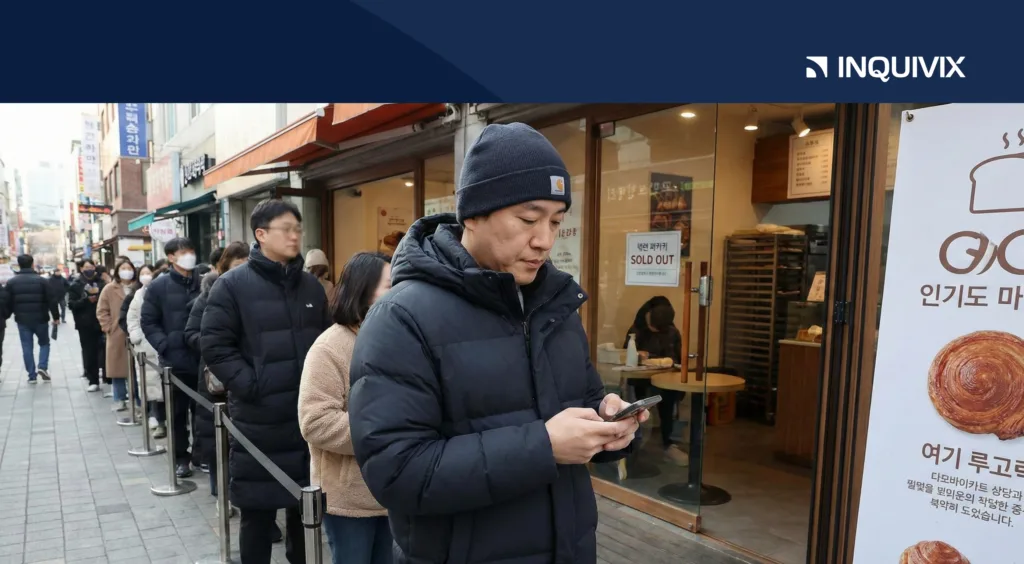
Neighborhoods like Seongsu-dong are the epicenters for marketing trends but they also act as a warning for investors. These areas thrive on aesthetics that may not have lasting utility for the consumer once the initial social media hype fades.
Digital Bricks over Product Utility
The MZ generation uses these spaces to collect photos which they treat as digital bricks to build their online personas. Once a location has been photographed by everyone it loses its primary value and the crowd moves to the next trending spot. This behavior is a primary driver behind the short lifespan of Korean consumer fads.
Hyper-Density and Rent Surges
Extreme competition leads to massive rent spikes in popular districts. Brands are often forced to close because the cost of maintaining a physical presence outweighs the declining revenue from a fading trend. This creates an unsustainable economic metabolism for many retail operators.
The Consumer Profile: Polarized and Discerning
The Korean consumer of 2026 is defined by demographic shifts and a move toward more deliberate spending. The market is polarizing between two major influential groups: the tech-savvy teens and the growing Silver Generation in their 50s and 60s.
The Teen Demographic: Digital Natives and Self-Expression
Teens in Korea are digital natives who have grown up in an era of ultra-low birth rates, giving them significant individual purchasing power within their families. They are the primary drivers of short-form content trends and prioritize products that aid in self-expression and identity building. For this group, consumption is an experience, and they are highly influenced by Gacha culture, which involves random draws and the excitement of unpredictable enjoyment.
The 50s Demographic: Stability and Fandom Culture
The demographic in their 50s is increasing in economic importance. They prioritize stability, quality, and practicality, yet they are also increasingly participating in fandom culture once dominated by youth. They represent the Longevity Generation, focusing on vitality span and preventative health. Marketing to this group requires a focus on authenticity and ethical standards, as they value brands that reflect their personal values and long term health goals.
| Demographic Group | Core Values | Platform Preference |
| Teens and Gen Z | Self-expression, novelty, and digital virality. | TikTok, Instagram, and YouTube Shorts. |
| Millennials (25-34) | Personalization, work-life balance, and wellness. | Instagram, KakaoTalk, and Naver Blog. |
| Silver Generation (50+) | Stability, quality, and community-driven fandoms. | KakaoStory, Naver Band, and YouTube. |
Strategic Recommendations for Global Brands
To achieve success in the high-velocity Korean market, global brands must go beyond simple translation and embrace deep cultural localization. The following strategies are essential for navigating the hidden lifecycle of Korean consumer fads and building a sustainable presence.
Prioritize Native Platform Dominance
Foreign brands often make the mistake of focusing solely on global platforms like Google and Instagram. To be visible and trusted in Korea, a brand must dominate the local ecosystem. This involves mastering Naver SEO by managing brand blogs and participating in Cafes, and utilizing KakaoTalk marketing for direct customer engagement.
Foster Peer-Reviewed Credibility
Korean consumers do not buy because an advertisement tells them to. They buy because a friend, an influencer, or a community forum has vouched for the product. Brands must cultivate this peer-reviewed credibility by partnering with a mix of influencer tiers and engaging with niche communities on Naver Cafes. Providing high quality customer service, with response times ideally within one hour, is also critical for maintaining trust.
Adopt a Multichannel and Mobile-First Strategy
With smartphone penetration exceeding 95%, a mobile-first strategy is non-negotiable. Marketing efforts must be consistent across multiple channels, from social media to mobile apps and offline pop-up stores. Optimization should include local payment gateways like KakaoPay and Naver Pay to reduce friction in the purchasing process. For businesses seeking a detailed roadmap, Inquivix offers expert market entry strategy consulting to help navigate these complexities.
Leverage Emotional and Visual Storytelling
In the era of the feelconomy, brands must move beyond functional benefits and connect with consumers on an emotional level. Using creative formats like webtoons, K-pop collaborations, and B-grade humor can make a brand more relatable and shareable. Visual appeal is also paramount. Products that are designed to be photogenic will thrive in the proof shot culture, accelerating their rise through social media virality.
Partner with Inquivix for Success in South Korea
Whether you need to master Naver SEO, launch a high-impact KOL and influencer marketing campaign, or develop a comprehensive market entry strategy consulting plan, our native experts are here to guide you every step of the way. Don’t let your brand become a forgotten fad. build a lasting legacy in South Korea with the right partner.