What is the Best Pop-Up Store Strategy for Korea? Why It’s No Longer Optional for New Brands

The “Seongsu-dong Effect” has transformed Seoul’s industrial alleys into the world’s most competitive retail battleground. Here, hundreds of Gen Z consumers wait in disciplined lines for brands they discovered just moments ago on social media. For global brands entering the market in 2026, these spaces have shifted from simple marketing stunts into a sophisticated, mandatory market entry strategy. With over 1,400 pop-ups launching in the first half of 2025 alone, this format now serves as the official “Grand Opening” signal to the Korean consumer.
In this hyper-connected ecosystem, a physical presence is the primary engine for building the trust required for online search validation. As we analyze Pop-up store trends in Korea 2026, it becomes clear that consumers follow a rigorous “Verify Everything” reflex. A physical visit triggers a critical digital loop: from a store encounter to a Naver search, and finally to long-term brand loyalty. This article explores why a localized pop-up store strategy for Korea is the only way to convert momentary curiosity into lasting market equity. If you are not visible on the streets of Seoul, you simply do not exist in the palm of the Korean consumer’s hand.
The Evolution of Pop-Up Store Strategy for Korea
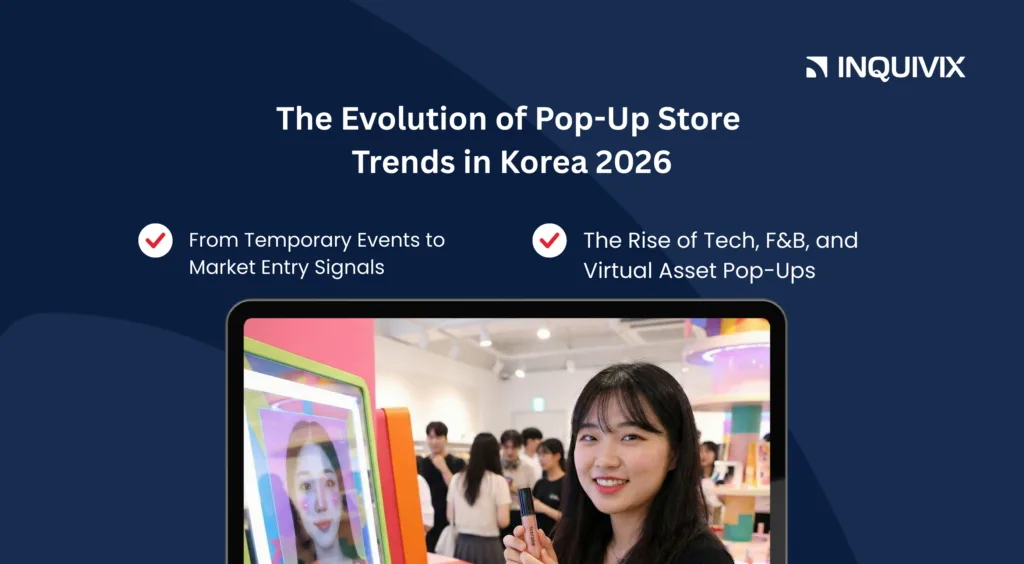
The retail landscape in Seoul has shifted from growth to hyper-saturation. In the first half of 2025 alone, Korea witnessed a staggering 1,488 pop-up operations, which more than doubled the volume from the previous year. This is no longer just a trend; it is an arms race for consumer attention. In 2026, a successful pop-up store strategy in Korea has moved beyond the simple goal of selling products to a more complex mission: establishing a permanent brand memory in a temporary space.
From Temporary Events to Market Entry Signals
Pop-ups have evolved far beyond their origins as simple neighborhood tests. In the current retail climate, they function as official market entries that announce a brand’s arrival in Korea with authority. A pop-up’s opening day is no longer just a trial run; it is a major milestone treated with the same prestige as a traditional flagship launch
The saturation of the market has forced a “survival of the most creative.” Because there are now close to 60 new pop-ups launching every week across Seoul’s major hubs, consumers have become highly selective. They no longer visit for the sake of novelty. Instead, they visit because a brand has successfully positioned its physical space as a cultural milestone. This shift explains why a pop-up store strategy in Korea must focus on high-concept execution to achieve market validation.
Beyond Fashion: The Rise of Tech, F&B, and Virtual Asset Pop-Ups
Perhaps the most significant shift in 2026 is the diversification of the industries entering the fray. While fashion and beauty once owned the pop-up scene, we are now seeing unconventional sectors, such as Tech, Finance, and even B2B corporations, using offline spaces to humanize their digital offerings.
- Palantir (AI)
The U.S. data firm launched a landmark B2B pop-up in Seongsu-dong to celebrate its massive retail investor fanbase. By selling exclusive merchandise and humanizing complex software through physical touchpoints, they successfully captured the unique fandom culture of South Korean investors.
- Upbit (Virtual Assets)
Korea’s top crypto exchange demystified digital finance at The Hyundai Seoul through an interactive Investment MBTI journey. This experiential approach transformed abstract financial services into a tangible and high-trust brand encounter for new investors.
- Super Handon Festa (F&B/Livestock)
The Korea Pork Producers Association turned a traditional commodity into a trending topic by hosting a participatory festival in Seongsu-dong. Featuring retro collaborations and sold-out BBQ events, they proved that even livestock brands can dominate Gen Z social feeds with the right experience design.
Understanding Korean Consumer Behavior: The Offline-to-Online (O2O) Loop
The success of a pop-up store strategy in Korea is not measured solely by foot traffic. Its true value lies in how effectively it triggers a digital chain reaction. In Korea, physical space ignites a complex offline-to-online consumerjourney that moves from the street to the smartphone in a matter of seconds.
The Trust Deficit for Global Brands
Korean consumers are famously sophisticated and remarkably risk-averse. When a new global brand enters the market, it faces an immediate trust deficit. Unlike consumers in many Western markets who might buy a product based on a single Instagram ad, Korean shoppers require multiple layers of validation. Without a local physical presence, a brand is often perceived as a ghost in the digital space. This skepticism is exactly why a comprehensive pop-up store strategy in Korea is required to provide the “Proof of Life” that locals demand.
The Search Journey: Discovery at the Store, Validation on Naver
To master the pop-up store strategy in Korea, brands must treat the physical venue as a data-capture point that feeds into a larger ecosystem. In this market, the consumer journey does not end at the checkout counter; it lives and breathes through digital validation. This is the heart of Korean consumer behavior, offline-to-online, where a physical encounter catalyzes a deep-dive digital investigation.
- Discovery (The Physical Spark)
The journey begins with high-impact visibility in a trending neighborhood like Seongsu-dong. Discovery is about stopping the “scroll” of real life. Whether it is a striking storefront or a viral social media mention, the initial contact must be strong enough to trigger the next phase of the pop-up store strategy in Korea.
- The Naver Reflex (The Real-Time Search)
The moment interest is piqued, the “Naver Reflex” kicks in. Most consumers will immediately search for the brand name followed by the keyword “pop-up” (팝업) to verify the event’s legitimacy. This is the most critical window for Naver SEO for new brands. If a searcher finds an empty results page or outdated information, the brand loses the “trust war” before it even begins.
- Third-Party Validation (The Review Loop)
Korean shoppers rely heavily on “View” search results, which aggregate Naver Blogs and Cafe posts. They are looking for peer-vetted content that showcases the “real” experience, unfiltered photos of the snacks, honest staff reviews, and proof of the “Instagrammable” factor. Successful Brand experience design in Seoul ensures that every corner of the store is a “content trap,” encouraging visitors to publish the very blogs that future customers will use for validation.
- Conversion (The Trusted Purchase)
Once the digital “Proof of Life” is confirmed through multiple third-party sources, the consumer moves to the final stage. This conversion might happen via Naver Pay at a kiosk inside the store or through a later purchase on Coupang. By bridging these steps, a well-executed pop-up store strategy in Korea converts momentary curiosity into a permanent, searchable record of brand equity.
Choosing Your Battleground: The “Holy Trinity” of Seoul Retail
| District | Primary Audience | Brand Vibe | Key Goal |
| Seongsu-dong | Gen Z / Alpha | Industrial-Chic, Experimental | Viral Social Media Buzz |
| The Hyundai Seoul | Premium Middle Class | Curated, High-Volume | Immediate Trust & Mass Exposure |
| Gangnam / Hannam | High-Net-Worth | Sophisticated, Exclusive | Prestige & Brand Authority |
In the competitive landscape of the South Korean market, location is not just about geography. It is about brand alignment and cultural context. For 2026, three specific districts have emerged as the “Holy Trinity” for any effective pop-up store strategy in Korea. Each neighborhood caters to a distinct demographic and requires a unique approach to experience design.
Seongsu-dong: The Global Hotspot for Gen Z and Tech
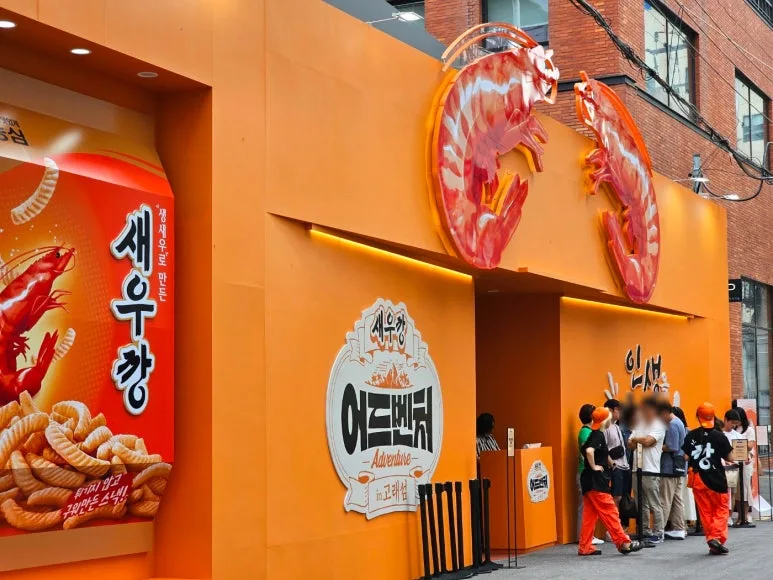
Saeu-kkang(새우깡) Pop up in Seongsu-dong
Often referred to as the “Brooklyn of Seoul,” Seongsu-dong has transitioned from an industrial hub of shoe factories into the city’s most experimental retail laboratory. The heart of this movement is Yeonmujang-gil, a street where raw industrial grit meets high-concept fashion and technology.
Seongsu-dong is the primary destination for brands targeting Gen Z and early adopters. The strategy here revolves around the “hip” factor and architectural transformation. Global giants and local startups alike utilize the neighborhood’s repurposed warehouses to create “Instagrammable” moments that feel authentic rather than corporate. If your goal is to generate massive social media buzz and engage with trendsetters, this is your primary battleground. For a deeper look at the evolution of this area, refer to the latest Seoul High Street Retail reports, which highlight how Seongsu has solidified its status as a global retail destination.
The Hyundai Seoul (Yeouido): The Premium Pop-Up Platform
If Seongsu is for the “hip,” The Hyundai Seoul is for the “curated.” Located in the financial district of Yeouido, this is arguably the most influential department store in modern Korean history. It has completely redefined the mall experience by dedicating significant square footage to nature and rest rather than just retail shelves.
The most critical area for new brands is the B2 Level, often called the “Dopamine Station.” This floor is a revolving door of the world’s most trending brands, from K-pop media exhibitions to global luxury collaborations. The strategy at The Hyundai Seoul is high-volume and high-visibility. Because the department store itself acts as a curator, being invited to host a pop-up here provides an immediate “seal of approval” for the Korean middle class and premium shoppers.
Hannam-dong & Gangnam: Luxury and Niche Lifestyle Positioning
While Seongsu and Yeouido focus on trends and volume, Hannam-dong and Gangnam cater to the affluent and the discerning.
- Hannam-dong
This area has become the headquarters for “sensibility-driven” fashion and niche lifestyle brands. It attracts a sophisticated crowd that values quiet luxury and artistic storytelling. A pop-up here should feel more like a gallery opening than a retail event.
- Gangnam (Apgujeong & Cheongdam)
This remains the “Luxury Spine” of Seoul. Recent market forecasts, such as the South Korea Luxury Goods Market Size & Forecast, indicate that this region continues to dominate high-end consumption. Pop-ups in Gangnam are about prestige, exclusivity, and high-touch service.
Brand Experience Design in Seoul: 5 Pillars of Success
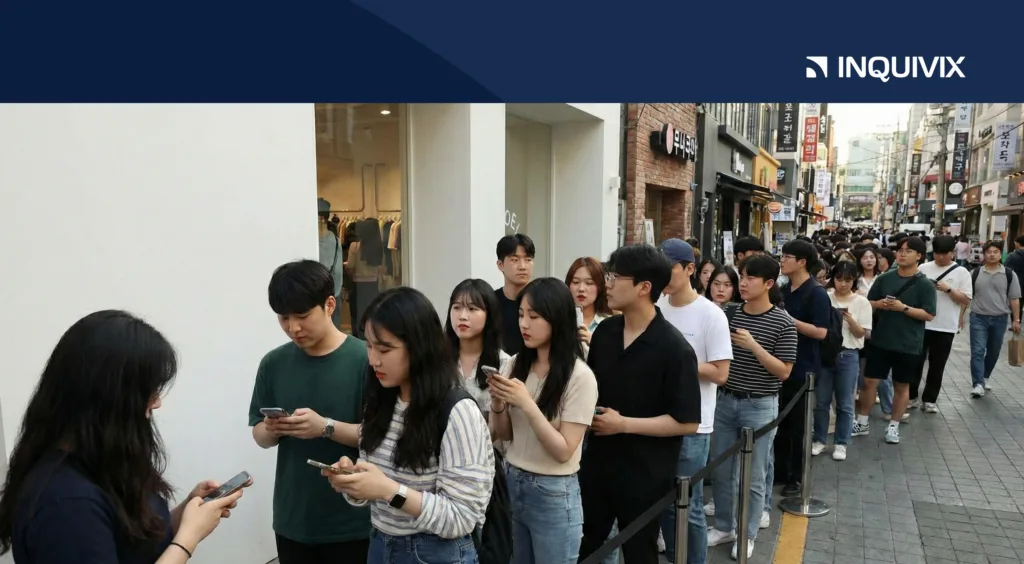
In a retail landscape dominated by the convenience of Coupang, physical stores must provide the biological and emotional connections that digital channels lack. A winning pop-up store strategy in Korea relies heavily on high-level Brand experience design in Seoul to create lasting impact.
- Multi-Sensory Engagement: Tasting, smelling, and touching are mandatory for building trust, especially for snack brands.
- Human Interaction: Staff act as brand curators who focus on emotional storytelling rather than aggressive selling.
- Space to Stay: Effective pop-ups function as urban sanctuaries where visitors are encouraged to linger.
- Visual Storytelling: Every angle of your pop-up store strategy in Korea must be designed for “the lens” to generate user content.
- Immediate Gratification: Scarcity and exclusive rewards provide digital status symbols that fuel the search loop.
Naver SEO for New Brands: Amplifying the Pop-Up Impact
A pop-up store strategy in Korea that lacks a digital echo is a wasted investment. You must ensure your brand dominates the local search results by prioritizing Naver SEO for new brands.
Why Your Pop-Up Needs a “Digital Footprint”
In Korea, search results on Naver are not just links; they are community trust. If your pop-up store strategy in Korea does not include a verified Naver Map listing and a wall of recent blog reviews, you do not exist to the local consumer. This digital presence acts as a permanent archive of your brand’s successful entry.
Strategic Checklist for New Global Snack and F&B Brands
International snack brands face unique hurdles. A well-executed pop-up store strategy in Korea helps lower the psychological barrier to trying foreign flavors through low-stakes sampling and “taste-first” experiences. Furthermore, a successful pop-up store strategy in Korea builds the B2B portfolio needed to negotiate with local distributors like GS25 or Olive Young.
Measuring Success: Naver Search Volume vs. Direct Sales
The primary KPI for a pop-up store strategy in Korea is not on-site revenue, but the increase in Naver Search Volume. You must track how many users “saved” your location on Naver Map and the quality of the blog reviews generated. This data is the real ROI of your pop-up store strategy in Korea.
Your pop-up store strategy in Korea should not end when the doors close. The “search equity” you build during the event provides the foundation for your long-term e-commerce presence. Every interaction within your pop-up store strategy in Korea should be viewed as a data point that informs your permanent market expansion.
The Future of Brand Equity in South Korea
In South Korea’s high-velocity market, these spaces are the foundation of credibility. A localized pop-up store strategy in Korea is the only bridge between momentary curiosity and lasting trust. By engineering a memory through a physical pop-up store strategy in Korea, you ensure your brand is validated both on the street and on the screen.
The streets of Seoul are waiting to tell your story. If you are ready to execute a world-class pop-up store strategy in Korea, start by integrating your physical experience with the digital search journey. Your brand’s market legacy begins with a single, perfectly executed pop-up store strategy in Korea.