Why Copying Korean Trends Almost Always Fails

The allure of South Korea as a global cultural powerhouse has reached an unprecedented peak in 2026. This has led many international brands to believe that they can simply mirror local trends to secure market share. This assumption is a profound strategic error.
The South Korean market is not merely a collection of aesthetic preferences or viral challenges. It is a complex, high density ecosystem governed by unique socio-economic pressures, deeply rooted cultural codes, and a digital infrastructure that operates independently of global standards.
When global firms attempt to replicate these trends without understanding the underlying mechanisms, they often find themselves alienated from the very consumers they wish to attract. Success in Seoul and beyond requires cultural fluency and platform-specific agility rather than superficial mimicry.
The Mirage of the Universal Trend and the Cost of Superficiality

The Korean Wave, or Hallyu, has created a deceptive sense of familiarity among Western marketers. They observe the success of K-beauty, K-pop, and the rapid adoption of tech-driven wellness trends like Sleepmaxxing and assume these can be exported or copied with a simple translation budget. However, the reality is that trends in South Korea are born out of a specific set of cultural dynamics. These include a high level of digital literacy, a collective mindset that values social consensus, and a hyper-competitive business environment that forces constant innovation.
Many brands enter the market viewing it as a test bed or a side market for larger Asian economies like China or Japan. This mindset leads to half-hearted launches with limited product lines and poorly localized campaigns that Korean consumers quickly perceive as inauthentic. The Korean consumer is among the most discerning in the world, expecting not just quality products but also exceptional service and a deep respect for their local culture.
| Metric | Global Average Approach | Korean Market Expectation |
| Localization Depth | Translation of global assets | Deep cultural adaptation of narratives |
| Digital Platform Focus | Google, Instagram, Facebook | Naver, KakaoTalk, YouTube, Coupang |
| Speed of Response | 24 to 48 hours for support | Immediate or near-instantaneous |
| Consumer Loyalty Basis | Brand history and global prestige | Authenticity, service, and local relevance |
The 2026 Economic Context: The Backfilled Strategy
To understand why copying trends fails in 2026, one must first look at the current economic landscape of South Korea. The Samsung Fashion Research Institute has identified “BACKFILLED” as the defining keyword for the year. This term reflects a market that has shifted away from aggressive, unbridled expansion toward a focus on operational efficiency and strategic reinforcement. Korean companies are currently responding to global uncertainty and a sluggish domestic market by filling gaps in their business structures rather than taking massive risks on new trends.
This shift toward defensive management means that consumers are also becoming more rational in their purchasing decisions. They are engaging in price decoding, where they analyze the margins and cost structures of products before buying. When a foreign brand attempts to copy a flashy, high-cost trend from the previous year, they may find themselves out of step with a consumer base that is now prioritizing value for money and practicality.
The Cultural Codes: Nunchi and Honorifics
A fundamental reason for the failure of trend mimicry is the misunderstanding of Korean social codes. The concept of nunchi, or social awareness, is central to all interactions in South Korea. It involves sensing the unspoken feelings and needs of others. In marketing, this translates to a brand’s ability to read the room and understand when a trend is being embraced versus when it is being forced.
Furthermore, the Korean language is a complex system of honorifics and politeness levels. A marketing campaign that uses the wrong tone can be seen as disrespectful or amateurish. For example, a brand might try to copy the B-grade (B-geup) marketing sentiment that uses quirky, low-budget humor to appeal to Gen Z. However, if the language used in that campaign does not correctly balance the informal vibe with the necessary cultural respect, it will fail to resonate.
The Collectivist Adoption Curve
Korean society is often characterized by a balance between collectivism and individual expression. Trends spread rapidly because of a desire for social consensus. When a trend like sleepmaxxing becomes popular, it is not just because individuals want better sleep. It is because the group has decided that sleep optimization is a vital part of a healthy, successful life in a high-pressure society. Global brands that treat these trends as individualistic lifestyle choices miss the social glue that makes them powerful.
The Naver and Kakao Fortress: A Closed Digital Ecosystem
Perhaps the most significant barrier for foreign brands is the unique digital landscape of South Korea. Unlike most Western markets where Google is the dominant gatekeeper, South Korea relies on a curated ecosystem led by Naver and KakaoTalk.
Naver is not just a search engine. It is a portal that prioritizes its own content, such as Naver Blogs, Naver Cafes, and Jisikin, which is a Q&A service.
A global SEO strategy that focuses on backlinks and external website authority will almost certainly fail on Naver. Instead, brands must manage their own Naver Brand Blogs and engage with local communities in Naver Cafes to build authority.
Similarly, KakaoTalk is used by over 98% of the population for everything from messaging to banking and gifting. A brand that does not have a sophisticated strategy for Kakao Marketing is effectively invisible to the vast majority of Korean consumers.
| Platform | Role in Korean Market | Strategic Requirement |
| Naver | Primary search and discovery portal | Brand blog management and VIEW tab optimization |
| KakaoTalk | Universal messaging and lifestyle app | Business channel setup, chatbots, and gifting |
| YouTube | Video consumption across all ages | High-quality localized video and short-form content |
| Coupang | Dominant e-commerce platform | Logistics integration and platform-specific ads |
| Trend discovery for younger cohorts | Visual storytelling and influencer collaborations |
The Walmart Autopsy: A Case Study in Strategic Rigidity
The failure of Walmart in South Korea remains one of the most cited examples of why global standardized strategies do not work in this market. Walmart entered the market in the late 1990s and attempted to replicate its successful American model of Every Day Low Prices (EDLP) and massive warehouse-style stores located in suburban areas.
However, the American giant failed to understand the shopping preferences of Korean consumers. At the time, Koreans preferred frequent, small-scale shopping trips to local urban locations rather than infrequent bulk shopping in the suburbs. They valued the freshness of products and a high energy shopping environment.
Local competitors like E-Mart succeeded because they brought the atmosphere of traditional outdoor markets indoors, with live seafood displays and staff who actively engaged with shoppers. Walmart’s sterile, box-filled aisles and focus on dry goods rather than fresh food alienated the local population, leading to its exit in 2006.
The Tesco Alternative
In contrast, the British retailer Tesco found success through a joint venture with Samsung. By hiring local managers and adapting their stores to the Korean preference for extra services and urban accessibility, Tesco managed to strike a balance between global efficiency and local relevance. This demonstrates that the issue is not that foreign brands cannot succeed, but that they must be willing to abandon their proven global playbooks in favor of local adaptation.
Sleepmaxxing: A 2026 Trend Analysis
The “sleepmaxxing” trend that has gained traction in 2026 is a prime example of a Korean trend that integrates deep wellness needs with advanced technology. For Gen Z in Korea, who have faced rising levels of anxiety and burnout, sleep has become a non-negotiable pillar of mental health. This is a significant shift from previous generations that glorified grind culture and sleepless nights.
This trend has driven the development of a sophisticated sleep-tech industry. Companies are no longer just selling mattresses. They are selling AI-driven sleep environments. For instance, Coway has released a smart mattress that uses air-filled sleep cells to adjust hardness based on the user’s body pressure. LG Electronics has introduced Brid.zzz, which is an earbud that measures brain waves in real-time to provide frequencies that induce sleep.
| Product / Trend | Mechanism | Targeted Benefit |
| Coway Berix Mattress | AI sleep cells and pressure analysis | Optimal sleeping posture and pressure relief |
| LG Brid.zzz Earbuds | Brain wave sensing and frequency matching | Faster sleep onset and deep recovery |
| 10Minds AI Pillow | Snoring pattern learning and head positioning | Airway opening to reduce snoring |
| Sleepy Girl Mocktail | Magnesium and tart cherry juice blend | Natural nervous system regulation |
| Mouth Taping | Medical-grade tape for nasal breathing | Snoring reduction and improved oxygen intake |
The Longevity Generation
In 2026, Gen Z and Millennials are being called The Longevity Generation. Their focus has moved past quick fixes toward vitality span, which means maximizing the number of years lived in peak condition. This explains why trends like Sleepmaxxing are not just passing fads but are integrated into a broader lifestyle of preventative health and wellness. Brands that try to copy the aesthetic of Sleepmaxxing without offering the technological substance or the mental health narrative will find their products collecting dust on the shelves.
AI and the Transformation of Creative Content
The role of artificial intelligence in Korean marketing has evolved from a novelty to a core strategic tool by early 2026. Large financial institutions like Samsung Securities and Shinhan Securities are now using AI to create entire digital ad campaigns, including background music and visual storytelling. This allows them to produce content that is highly personalized and reactive to current trends with minimal lead time.
One of the most significant AI-driven projects of 2026 is “The Christmas Song,” an urban fairy tale directed by Shin Wooseok in collaboration with Google Gemini. This project used top stars like Byeon Wooseok, Karina, and Jang Wonyoung to tell a deeply emotional story of forgiveness and reconciliation. The campaign succeeded because it used AI to enhance the human narrative rather than just showing off technical capabilities. It presented AI as a tool for preserving innocence and creating miracles, which resonated with the emotional sensibilities of the Korean audience.
The Shin Wooseok Directorial Style
Director Shin Wooseok is known for a strong style that often incorporates elements of “jeong,” which refers to deep emotional bonds, and “han,” which is a unique Korean sense of sorrow or longing. These emotional undercurrents are vital for connecting with Korean viewers. A global brand that attempts to copy the cinematic look of a Shin Wooseok ad without understanding these emotional pillars will likely produce content that feels hollow.
The B-Grade Aesthetic and the Power of Humor
Another trend that is frequently misunderstood by foreign brands is the B-grade (B-geup) or bottle-taste marketing sentiment. This style intentionally uses low-fidelity visuals, puns, and self-deprecating humor to create an approachable brand image. It is particularly effective for large, conservative corporations that want to connect with younger consumers.
For example, SK Hynix released HBM Chips, which is a snack with a honey banana flavor that used the abbreviation for High Bandwidth Memory. This clever use of a pun allowed a complex semiconductor company to engage in a fun, relatable way with the general public. Similarly, the entertainer Noh Hong-chul established a production company focused on B-grade visuals, famously turning himself into a robot for a ZIC engine oil commercial. These campaigns work because they feel authentic and unpretentious, which are qualities that are highly valued by Korean Gen Z.
Cross-Industry Collaborations as a Branding Strategy
In 2026, cross-industry collaborations have become a mandatory strategy for major Korean brands. These partnerships allow companies to leverage each other’s brand equity and create unique experiences that generate viral social media content.
- Samsung Electronics x Maeil Dairies: Creating Galaxy Buds cases that look exactly like Almond Breeze milk cartons to provide a fun, tactile experience.
- Kia x Musinsa: Opening a pop-up store where the design of the EV4 car inspired a fashion pictorial, targeting trend-sensitive fashion consumers.
- SK Hynix x Seven-Eleven: The aforementioned HBM Chips to make a B2B tech brand familiar to consumers.
These collaborations are not random. They are carefully designed to create Instagrammable moments and to position traditional brands as modern and culturally relevant. A global brand that tries to replicate this by simply putting two logos together will likely fail to see the same engagement if there is no genuine creative synergy or fun factor involved.
The Reality of Influencer Marketing in Korea
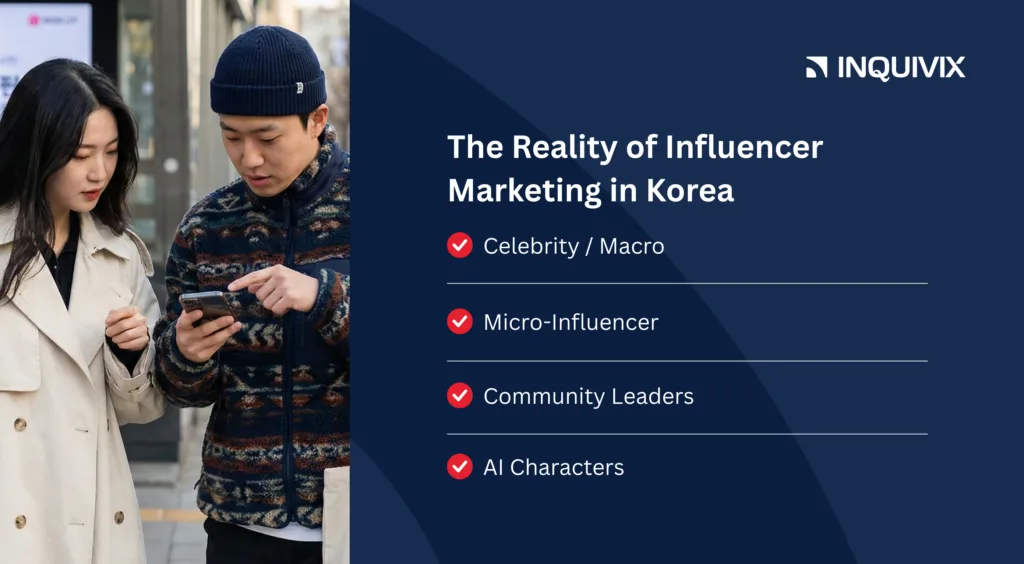
Influencer marketing in South Korea has moved past the era of simply hiring celebrities with large followings. In 2026, the focus has shifted toward micro-influencers and niche experts who have high levels of trust with their specific communities. These Key Opinion Leaders (KOLs) are essential for ranking in the Naver VIEW tab, which is where most Korean consumers go to find reviews and authentic recommendations.
One of the biggest challenges for global brands is the prevalence of fraudulent influencers. Vetting creators based on engagement quality rather than just follower counts is a critical skill that many international agencies lack. Successful campaigns often coordinate hundreds of micro-influencers simultaneously to create a commercial-level buzz that feels organic and community-driven.
| Influencer Type | Primary Value | Platform Dominance |
| Celebrity / Macro | Mass awareness and brand prestige | YouTube, Instagram |
| Micro-Influencer | Niche trust and high engagement | Naver Blog, Instagram |
| Community Leaders | Peer-to-peer influence and advocacy | Naver Cafes, Open Chats |
| AI Characters | Consistent persona and safe branding | SNS, Company Portals |
A Path to Genuine Success
To avoid the failures associated with copying Korean trends, foreign brands need a partner that can provide a full-funnel strategy tailored to the local market. Inquivix has developed a methodology that focuses on localized SEO, community management, and culturally intelligent advertising. Our results speak for themselves, with a 200% traffic growth for beauty brands and a 490% increase in social media engagement for lifestyle brands.
Naver SEO Optimization
Our approach is built on the understanding that Naver is a closed garden. Instead of chasing global metrics, we focus on:
- Keyword Research Native to Naver: Identifying how Koreans actually search, using autocomplete and suggestions from the platform itself.
- SERP Reverse Engineering: Analyzing every priority keyword to see which platform Naver’s algorithm is currently favoring for that specific topic.
- Strategic Content Deployment: Creating native-style content that appeals to the buyer psychology of Koreans, who often prefer long-form, detailed information.
KakaoTalk and Community Marketing
Building a presence on KakaoTalk is the only way to maintain a direct line of communication with the Korean consumer. Inquivix manages everything from business channel setup to the integration of intelligent chatbots that can handle customer inquiries in real-time. We also recognize the power of Naver Cafes, which are hyper-local communities where brands can engage in peer-reviewed discussions. This organic participation is far more effective at building trust than traditional display advertising.
Trends to Watch in 2027
As South Korea continues to be the cultural tone-setter for Asia and the world, several emerging trends will dominate the landscape through 2027. Sustainability is becoming a necessity in the beauty and fashion industries, with brands shifting toward plastic-free initiatives and biodegradable packaging to meet growing ethical demands. Furthermore, the convergence of beauty and advanced technology, or health hacking, is accelerating. This includes a focus on prejuvenation and the use of at-home medical-grade devices like LED masks.
Global brands that wish to enter the market must be prepared for stricter regulatory requirements regarding ingredient transparency and environmental impact. Those that fail to improve their transparency or fail to adapt to local cultural nuances will find themselves losing the vital younger consumer segment that prioritizes ethics as much as efficacy.
The High Speed and High Standards of Korea
The Korean market is defined by its speed. Consumers expect immediate gratification and seamless digital experiences. A website that loads slowly or a customer service representative who does not understand the nuances of Korean honorifics can destroy a brand’s reputation overnight. Success in this environment is not about resting on global achievements but about continually refreshing one’s offerings and showing a genuine commitment to the local market.
Foreign companies that treat South Korea as a simple extension of their global strategy are destined to fail. Those that succeed are the ones that approach the market with humility, respect for the local culture, and a willingness to invest in the specialized expertise needed to navigate its unique digital and social landscape.