Korea is one of the most digitally advanced markets in the world, and one of the most difficult for foreign companies to crack. The search engines are different, the social platforms are different, and the consumer expectations are different. Succeeding here requires more than adapting a global playbook. It requires a digital marketing agency built for the Korean market from the ground up. Inquivix is a Seoul-based digital marketing agency that helps international brands enter, localize, and scale in South Korea. We operate across every major Korean platform (Naver, Kakao, Korean social media, and global channels) with a bilingual team that executes in Korean, reports in English, and measures everything in revenue.
Why winning in Korea requires a different digital playbook
Korea is one of the most digitally advanced markets in the world - and one of the most difficult for foreign companies to crack. The search engines are different, the social platforms are different, and the consumer expectations are different. Succeeding here requires more than adapting a global playbook. It requires a digital marketing agency built for the Korean market from the ground up.
INQUIVIX is a Seoul-based digital marketing agency that helps international brands enter, localize, and scale in South Korea. We operate across every major Korean platform - Naver, Kakao, Korean social media, and global channels - with a bilingual team that executes in Korean, reports in English, and measures everything in revenue.
“
In Korea, the best marketing speaks the local language: on the right platform, in the right way, at the right time.
Platform-First Strategy
Cultural & Language Fluent Execution
End-to-End Growth Partnership
WHY KOREA REQUIRES A DIFFERENT APPROACH
Why digital marketing in Korea is different from every other market.
South Korea has a 97.6% internet penetration rate, the fastest average broadband speeds in the world, and a population of 52 million consumers who spend more time online per capita than virtually any other nation.
Korea has world-class digital infrastructure, fast-moving consumer expectations, and platform habits that do not behave like the US or Europe. Performance in Korea depends on local platform fluency, not just translated global campaigns. The difference is most obvious when you compare what Koreans actually see in search and messaging environments.
97.6%Internet Penetration
#4E-Commerce Market in Asia
52MDigital Consumers
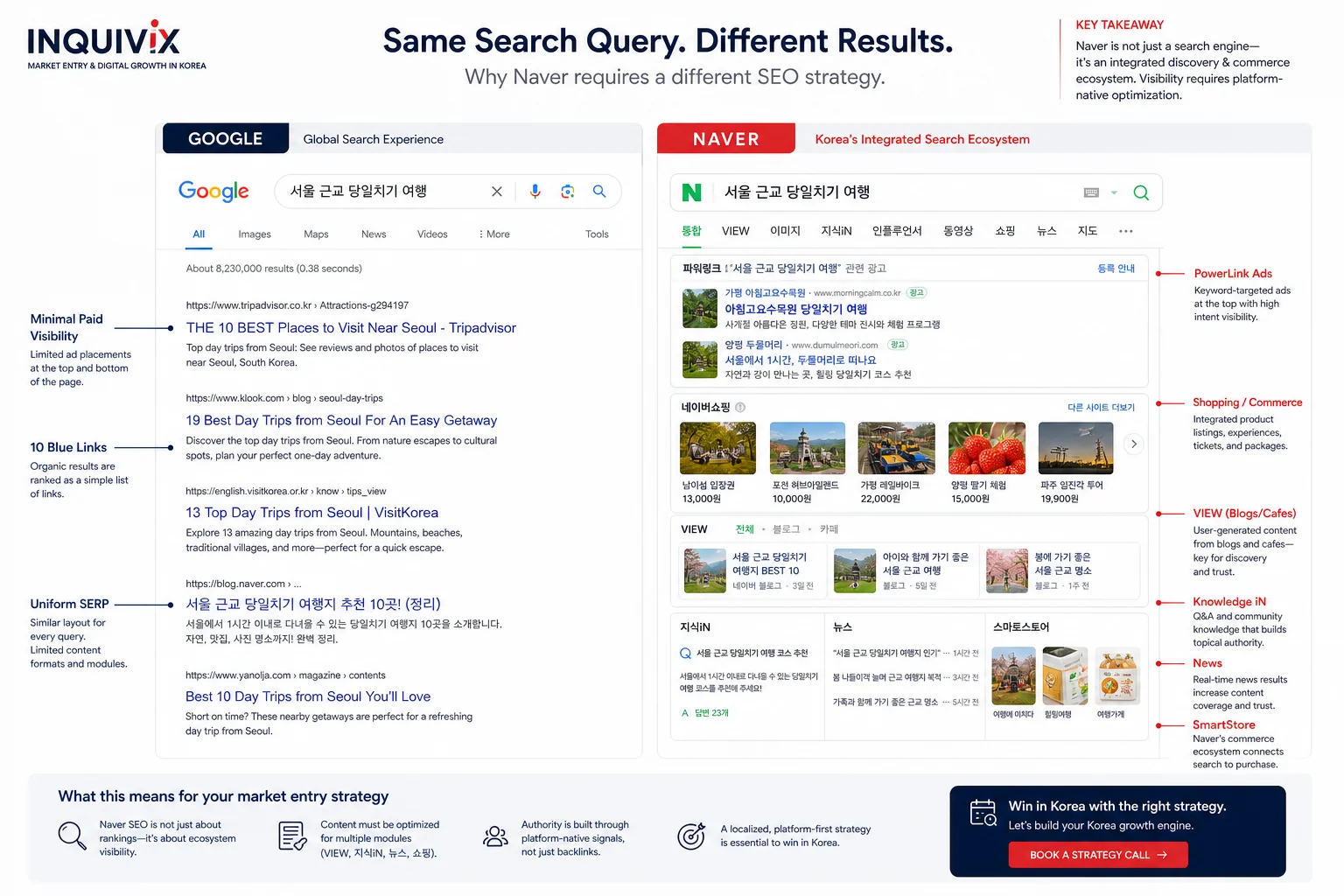
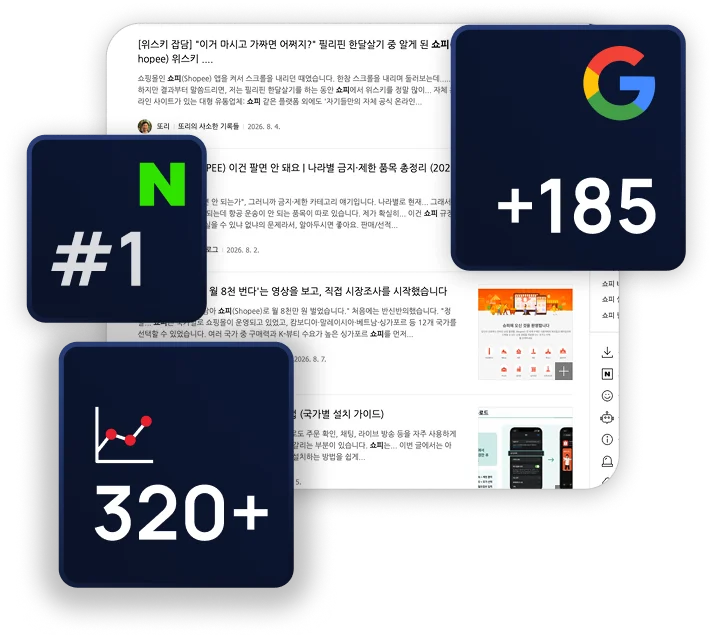
LIVE SERP COMPARISON
Same search query, different market logic. Naver prioritizes its owned ecosystem before external websites.
01
Naver, not Google, is where Koreans search
Google holds roughly 30-35% of Korean search traffic. Naver holds over 60% for Korean-language queries. More importantly, Naver's search results page is fundamentally different - it displays results from its own ecosystem before showing external websites. A website that ranks on Google may be virtually invisible on Naver.
SEO in Korea is a separate discipline. Naver SEO requires optimized publishing across Naver Blog, Naver Cafe, Knowledge iN, and SmartStore, plus an understanding of ranking signals like C-Rank and DIA that do not map cleanly to Google SEO.
KakaoTalk is the operating system of Korean daily life
KakaoTalk is how Koreans pay for things, hail taxis, check the news, manage loyalty programs, and communicate with businesses. For marketers, KakaoTalk Channels, Kakao Bizboard, and Kakao Moment are not optional channels - they are core infrastructure.
International brands that ignore Kakao stay invisible during some of the highest-intent daily interactions Korean consumers have.
Korean social media runs on different platforms and different rules
Instagram has significant reach in Korea, YouTube is dominant for video, and TikTok is growing quickly. But Korean consumers also rely heavily on Naver Blog reviews, KakaoTalk group chats, and community-driven spaces like Naver Cafe during product discovery and trust validation.
Effective social media marketing in Korea requires platform-specific behavior mapping and content calibrated to Korean cultural norms, aesthetic standards, and trust signals.
Korean consumers can detect machine-translated or poorly localized content immediately, and it destroys credibility. Korean digital content requires native-level copywriting, an understanding of honorific language registers, platform-specific formatting for Naver and Kakao, and visual design conventions that differ significantly from Western standards.
Content that feels foreign performs poorly regardless of how much budget sits behind it.
South Korea's digital market is not driven by a single dominant channel. It is an interconnected ecosystem where search, messaging, video, social, commerce, and community all influence buyer behavior in distinct ways.
Naver Search and Content
Naver shapes discovery through search results, Blog content, Shopping visibility, Cafe community trust, and Knowledge iN answers.
Naver BlogCafeKnowledge iN
Read platform context
Naver Blog, Naver Cafe, Naver Knowledge iN, and Naver SmartStore collectively influence Korean consumer discovery and purchase decisions in ways that have no direct equivalent in Google's ecosystem. C-Rank and DIA are Naver's proprietary authority signals - they reward consistent platform-native publishing, not external backlink profiles. Ranking on Naver requires operating inside its ecosystem, not just optimizing a website.
Kakao Ecosystem
Kakao connects messaging, advertising, brand channels, loyalty, and everyday commerce into a single daily environment.
KakaoTalkBizboardMoment
Read platform context
KakaoTalk is used by over 90% of the Korean population daily. For brands, this means Kakao Bizboard, Kakao Moment, and KakaoTalk Channels create touchpoints inside a consumer's daily communication habits - not as interruptions, but as part of the native experience.
YouTube Korea
Video is a major decision-support medium for Korean consumers, used for education, product comparison, and creator validation.
Video searchCreatorsShorts
Read platform context
YouTube is the dominant video platform in Korea. Korean consumers use long-form and short-form video not just for entertainment but as a trusted source for product research, brand comparison, and purchase validation. Creator content on YouTube carries strong trust signals - particularly for categories involving considered purchases, beauty, tech, and lifestyle.
Instagram and Short-Form Social
Visual brand presence matters, but Korean users expect significantly higher production quality and native aesthetic than most Western markets.
InstagramTikTokReels
Read platform context
Instagram has significant reach in Korea, particularly among younger demographics. TikTok is growing rapidly. But Korean social engagement differs from Western patterns - platform-specific formatting, native aesthetic conventions, and creator alignment matter more than repurposed global creative. Content that feels foreign consistently underperforms regardless of budget.
Commerce Platforms
Coupang, Naver SmartStore, and direct D2C channels each play different roles in discovery, trust, and conversion.
CoupangSmartStoreD2C
Read platform context
E-commerce in Korea is split across multiple surfaces. Naver SmartStore integrates search visibility with transaction, making it a critical channel for brands targeting Korean-language queries. Coupang dominates convenience-driven purchase behavior. Direct D2C sites require Korean SEO, localized UX, and Korean-language content to compete. Each channel has a distinct role in the funnel.
Community and Reviews
Naver Blog reviews and community forums remain central to purchase trust formation in Korea.
ReviewsNaver CafeQ&A
Read platform context
Korean consumers rely heavily on Naver Blog content as purchase validation - often more than Instagram or brand advertising. Naver Cafe functions as both a product research forum and a peer trust network. A brand's presence in these community surfaces influences consideration and purchase confidence in ways that paid media alone cannot replicate.
OUR KOREA DIGITAL MARKETING SERVICES
What a Korea-focused digital marketing agency actually does.
Most global agencies treat Korea as an adapted variant of a global strategy with translated websites and freelance consultants. INQUIVIX was built for Korea from day one, operating directly from Seoul with dedicated native infrastructure.
THE INQUIVIX ADVANTAGE
Seoul HQ Operations
On-the-ground execution from our Seoul office.
Direct Accounts
Direct accounts on Naver, Kakao, & Meta.
Native Localization
Cultural resonance, not raw machine translation.
Global Reporting
Transparent analytics tailored for Western HQ leadership.
Service EcosystemINQUIVIX
Strategy, execution, localization, reporting.
N
Naver SEO and search marketing
We manage Blog SEO, Cafe community programs, Knowledge iN authority building, and SmartStore optimization, then measure performance through Naver Search Advisor and Naver Analytics. When brands need Google visibility too, we run parallel search strategies without confusing the two ecosystems.
We handle Kakao Bizboard, Kakao Moment, and KakaoTalk Channel strategy, including setup, targeting, creative production, performance optimization, and ongoing communication design for brands that need a persistent presence inside KakaoTalk.
Beyond Naver and Kakao, we manage paid media campaigns on Google Ads, Meta (Facebook and Instagram), YouTube, and TikTok, all calibrated for Korean audience behavior. Korean CPCs, conversion patterns, and creative preferences differ from global benchmarks. We structure every campaign for measurable return, not reach.
We identify the right Korean creators, negotiate partnerships in Korean, manage production quality, and measure commercial impact across Naver Blog, YouTube, Instagram, and TikTok - from targeted seeding to top-tier KOL launches.
We run organic social programs on Instagram, YouTube, TikTok, Naver Blog, and Naver Cafe with Korean-native content calendars, community management, reporting, and paid-media integration.
Korea's consumer culture is highly activation-driven. Pop-up stores in Seongsu-dong and Gangnam, brand collaborations with Korean designers, experiential retail, and media events generate outsized attention and social sharing. We plan, produce, and amplify brand events end-to-end: from venue sourcing and Korean media outreach to influencer attendance and post-event content distribution.
How international companies grow in Korea with | Inquivix
Whether you are entering Korea for the first time or scaling an existing presence, we use a structured methodology designed to reduce risk and compress timelines.
01
Step 01
Market Research and Strategy
We start with research, not assumptions: category-specific competitor analysis, keyword research across Naver Data Lab and Google Keyword Planner, Korean audience mapping, channel strategy, KPIs, and a realistic timeline.
Deliverables
competitive landscape analysis
Naver and Google keyword research
audience mapping
channel strategy
KPI framework
budget recommendations
02
Step 02
Localization and Launch
We localize the site and content, complete platform setup, verify tracking, activate paid media, and manage influencer and channel launches with assets produced in Korean by our Seoul team.
Deliverables
website and content localization
Naver Search Advisor setup
Kakao Business verification
campaign launch
influencer coordination
analytics configuration
03
Step 03
Optimization and Scale
We refine targeting, expand into new channels as results justify it, test creative across Korean seasonal cycles, and report outcomes in formats that make sense to global stakeholders.
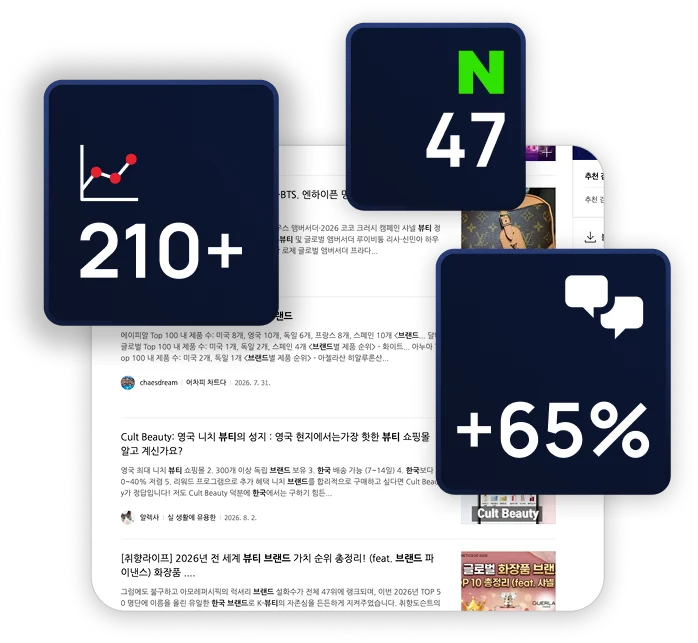
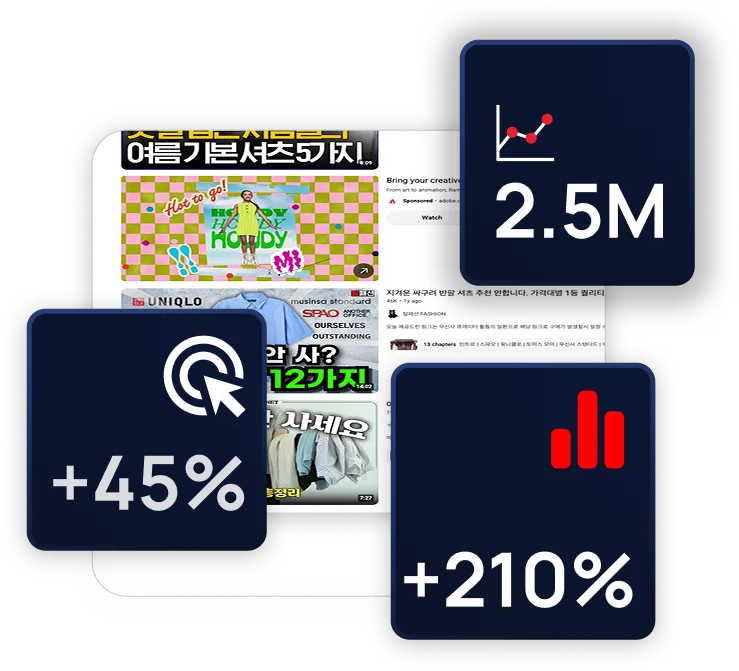
Representative outcomes across market entry, organic visibility, and brand awareness programs. Brand names remain anonymized here until explicit publication permissions are confirmed.
If your brand needs to reach Korean consumers or Korean businesses and your team does not have in-house Korean digital marketing capability, this is the gap we fill.
New Entry
Market entry
Global brands launching in Korea for the first time and needing research, strategy, localization, and campaign execution from scratch.
Scaling
Growth and scale
Companies with an existing Korean presence that need faster results, broader channel coverage, or a fix for underperforming campaigns.
B2B
B2B and enterprise
Industrial, SaaS, and technology companies targeting Korean business buyers through Naver search, LinkedIn Korea, and industry content.
Commerce
E-commerce
Consumer brands selling through Naver SmartStore, Coupang, or their own Korean-language site and needing search visibility plus performance marketing.
A page like this only works when the commercial story is backed by market reality. These are the signals global brands need to understand before planning channel mix, localization depth, and investment pace.
52MPopulation97.6%Internet penetrationUS$206BE-commerce market size60%+Search traffic through Naver90%+Daily KakaoTalk usage$7.8BDigital advertising spend89%Smartphone penetration#4Largest e-commerce market in Asia
Sources referenced in the brief: Statista, DataReportal, and the Korea Internet & Security Agency.
FAQ
Frequently asked questions about digital marketing in Korea
A Korean digital marketing agency is a marketing firm that specializes in helping businesses reach Korean consumers through Korea's unique digital ecosystem. This includes platforms like Naver (Korea's dominant search engine), KakaoTalk (the universal messaging and commerce platform), and Korean social media channels. Unlike general digital marketing agencies, a Korea-focused agency operates with Korean-language capabilities, direct advertising accounts on Korean platforms, and in-market expertise in Korean consumer behavior and regulatory requirements.
Costs vary significantly depending on scope, channels, and objectives. Naver keyword advertising (PowerLink) typically has lower CPCs than Google Ads for equivalent intent, but Naver requires additional investment in content marketing (Blog SEO, Cafe seeding) that has no direct equivalent in Google's ecosystem. A comprehensive Korea digital marketing program for an international brand typically ranges from $5,000 to $25,000 per month in agency fees, plus ad spend. Smaller, single-channel engagements such as Naver Blog SEO or Kakao Channel management may start lower. The most reliable way to get a cost estimate is to get in touch so we can scope your specific objectives.
You can manage the strategy and business decisions in English, but the execution (content production, advertising copy, influencer communication, platform management, and customer engagement) must be done in Korean. Korean consumers strongly prefer native-language content, and the major Korean platforms (Naver, Kakao) require Korean-language operations. This is one of the primary reasons international brands work with a Korea-based agency rather than trying to manage Korean marketing remotely from a global office.
Paid media campaigns on Naver and Kakao can generate qualified traffic within the first two weeks. Naver Blog SEO and organic search visibility typically require three to six months of consistent content publishing before meaningful ranking improvements appear. Influencer campaigns produce measurable engagement within the campaign period, usually four to eight weeks. A comprehensive market entry program combining paid, organic, and influencer channels generally reaches a performance baseline within the first 90 days.
It depends on the platform and campaign type. Some Korean advertising platforms, including certain Naver ad formats and Kakao Bizboard, require a Korean business registration number (사업자등록번호) or a Korean business entity to open an advertising account. An agency like INQUIVIX that already holds Korean advertising accounts can run campaigns on your behalf without requiring you to register a Korean entity, though you may still need one for other business reasons such as Korean tax obligations, importing goods, or financial transactions.
Naver SEO and Google SEO are fundamentally different disciplines that require separate strategies. Google ranks external websites in its organic results based on factors like backlinks, technical SEO, and content relevance. Naver prioritizes its own ecosystem (Naver Blog, Naver Cafe, Naver Knowledge iN, and Naver SmartStore), displaying these results above external websites. Ranking on Naver requires publishing optimized content directly on Naver's owned platforms, building C-Rank and DIA authority scores, and maintaining consistent publishing frequency. A page that ranks well on Google in Korea may have zero visibility on Naver, and vice versa.
01
What is a Korean digital marketing agency?
A Korean digital marketing agency is a marketing firm that specializes in helping businesses reach Korean consumers through Korea's unique digital ecosystem. This includes platforms like Naver (Korea's dominant search engine), KakaoTalk (the universal messaging and commerce platform), and Korean social media channels. Unlike general digital marketing agencies, a Korea-focused agency operates with Korean-language capabilities, direct advertising accounts on Korean platforms, and in-market expertise in Korean consumer behavior and regulatory requirements.
02
How much does digital marketing in Korea cost?
Costs vary significantly depending on scope, channels, and objectives. Naver keyword advertising (PowerLink) typically has lower CPCs than Google Ads for equivalent intent, but Naver requires additional investment in content marketing (Blog SEO, Cafe seeding) that has no direct equivalent in Google's ecosystem. A comprehensive Korea digital marketing program for an international brand typically ranges from $5,000 to $25,000 per month in agency fees, plus ad spend. Smaller, single-channel engagements such as Naver Blog SEO or Kakao Channel management may start lower. The most reliable way to get a cost estimate is to get in touch so we can scope your specific objectives.
03
Can I do digital marketing in Korea without speaking Korean?
You can manage the strategy and business decisions in English, but the execution (content production, advertising copy, influencer communication, platform management, and customer engagement) must be done in Korean. Korean consumers strongly prefer native-language content, and the major Korean platforms (Naver, Kakao) require Korean-language operations. This is one of the primary reasons international brands work with a Korea-based agency rather than trying to manage Korean marketing remotely from a global office.
04
How long does it take to see results from Korean digital marketing?
Paid media campaigns on Naver and Kakao can generate qualified traffic within the first two weeks. Naver Blog SEO and organic search visibility typically require three to six months of consistent content publishing before meaningful ranking improvements appear. Influencer campaigns produce measurable engagement within the campaign period, usually four to eight weeks. A comprehensive market entry program combining paid, organic, and influencer channels generally reaches a performance baseline within the first 90 days.
05
Do I need to register a Korean business entity to advertise in Korea?
It depends on the platform and campaign type. Some Korean advertising platforms, including certain Naver ad formats and Kakao Bizboard, require a Korean business registration number (사업자등록번호) or a Korean business entity to open an advertising account. An agency like INQUIVIX that already holds Korean advertising accounts can run campaigns on your behalf without requiring you to register a Korean entity, though you may still need one for other business reasons such as Korean tax obligations, importing goods, or financial transactions.
06
What is the difference between Naver SEO and Google SEO in Korea?
Naver SEO and Google SEO are fundamentally different disciplines that require separate strategies. Google ranks external websites in its organic results based on factors like backlinks, technical SEO, and content relevance. Naver prioritizes its own ecosystem (Naver Blog, Naver Cafe, Naver Knowledge iN, and Naver SmartStore), displaying these results above external websites. Ranking on Naver requires publishing optimized content directly on Naver's owned platforms, building C-Rank and DIA authority scores, and maintaining consistent publishing frequency. A page that ranks well on Google in Korea may have zero visibility on Naver, and vice versa.
START GROWING
Start growing in Korea
Whether you are entering the Korean market for the first time or looking to scale an existing presence, the first step is the same - a focused conversation about your goals, your category, and the opportunity in front of you.
Get in touch with our Korea team. No pitch deck. No pressure. Just an honest assessment of what it would take to grow your brand in one of the world's most dynamic digital markets.