Inquivix HQ
402-A 1198, 12, Teheran-ro 70-gil, Gangnam-gu, Seoul, Korea 06193
R08, 1-101 B1 108, 95 Dongdaegu-ro, Suseong-gu, Daegu, Korea 42170
Inquivix HQ

For any global brand looking to enter the East Asian market, South Korea represents a unique challenge and a massive opportunity. With an internet penetration rate of 97.4% and a population that is smartphone-connected in the 18-34 demographic, the digital economy here is one of the most advanced in the world. However, traditional global marketing strategies often fail because South Korea operates within its own distinct digital ecosystem. At the heart of this ecosystem is the Naver search engine.

To understand Naver Korea, one must first recognize that it is not just a search bar, it is a comprehensive “Super-App” and web portal. While Google focuses on providing a clean list of external links, Naver functions more like a digital town square, integrating news, email, community forums, shopping, and encyclopedia entries into a single interface.
In mid-2025, domestic traffic data indicates that Naver holds approximately 51% to 56% of the search market, significantly ahead of Google’s 31% to 41%. For international businesses, being visible on Naver South Korea is the primary gateway to consumer trust and brand recognition.
Naver’s dominance stems from its superior ability to process the Korean language (Hangul) and its deep integration of local services like Naver Maps, Naver Pay, and Naver Weather. Unlike Western users who often prefer short-tail keywords, Korean consumers tend to use longer, more conversational queries, often looking for direct recommendations or reviews. Naver’s algorithm is specifically optimized for these local nuances, making it the “leading search engine” for anyone living in the country.

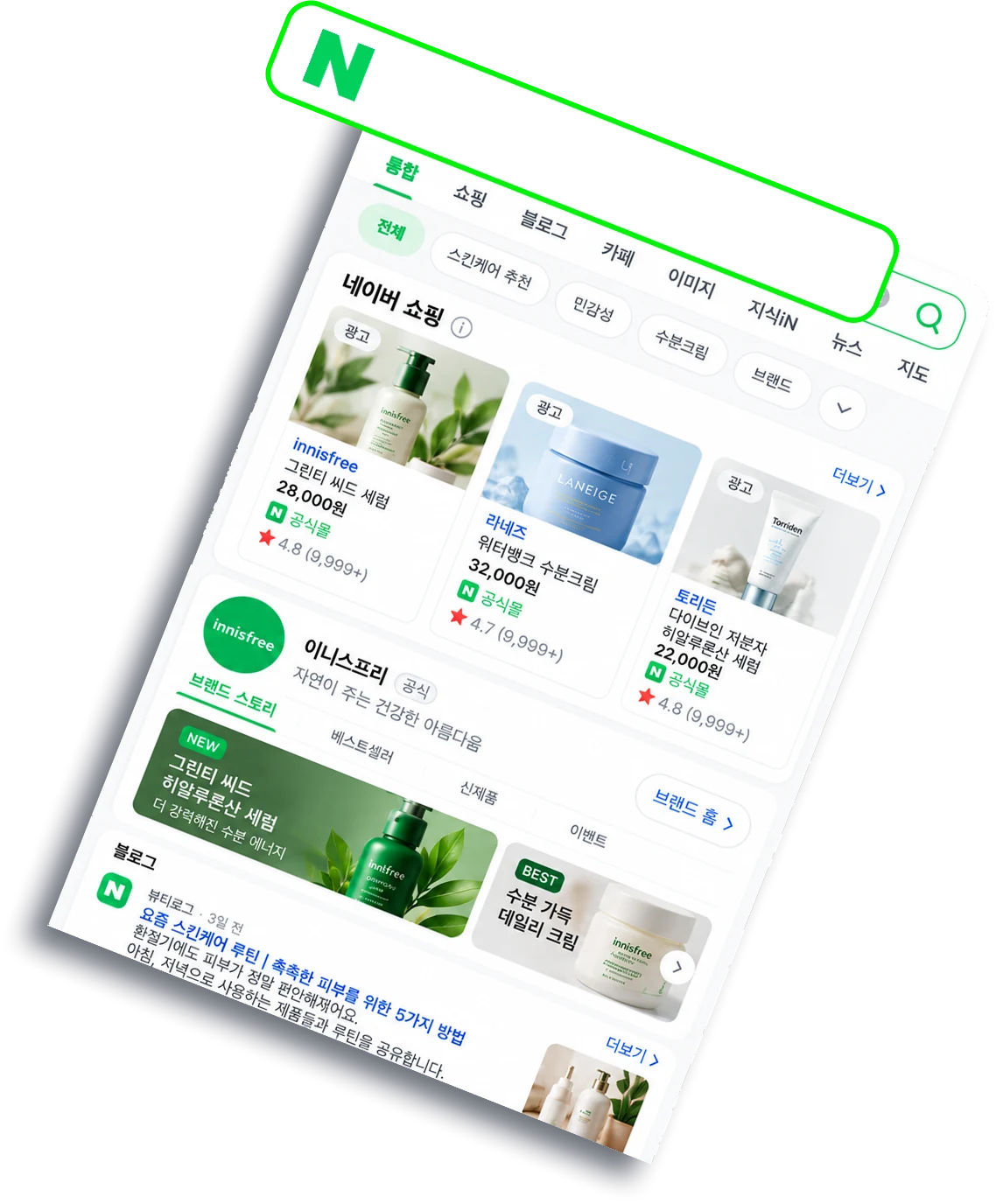
The most striking difference for those new to Naver in Korea is the “Integrated Search” (Tonghap Geomsaek) layout. Instead of a uniform list of blue links, Naver categorizes results into vertical sections based on content type and user intent.
| SERP Section | Content Source | User Purpose |
| Powerlinks | Paid Search Ads | Direct commercial discovery. |
| VIEW | Blogs and Cafes | Researching reviews and real experiences |
| Knowledge iN | Q&A Forum | Finding answers to specific questions |
| Shopping | Smart Store / E-commerce | Comparing prices and making purchases |
| Websites | External URLs | Official brand information and global data |
For competitive keywords, the top of the SERP is typically occupied by Powerlink Ads. Naver can display up to 10 text-based ads in this section, following a bidding system that prioritizes relevance and quality.
For brands seeking to establish authority, Brand Search Ads are essential. These are high-visibility, image-rich banners that appear at the very top of the page when a user searches for your specific brand name. They allow companies to own the initial impression and direct users to their Naver Blog, Smart Store, or official website. Brands often combine these with PPC advertising in Korea to dominate high-intent keywords during product launches.
On Naver, “real SEO” often happens inside the platform’s own properties rather than on your standalone website. Because Naver favors its own ecosystem, an effective offsite strategy is critical for visibility. To succeed, businesses must move beyond traditional and actively participate in the community segments of the Naver SEO.
Before a consumer buys from an international brand, they check its legitimacy. Naver Encyclopedia entries provide a foundation of trust. These authoritative pages often rank near the top of search results and serve as a “digital business card” for your brand in Korea.
Launched long before platforms like Quora, Knowledge iN is one of the world’s largest Q&A databases, with over 800 million pieces of knowledge data. Brands can leverage this section by professionally answering user queries related to their industry. This not only builds credibility but also secures prominent placements for interrogative searches.
The Naver Blog is the most important platform for organic marketing in South Korea. Over 80% of Korean consumers research products on Naver Blogs before making a purchase.
Naver Cafes are interest-based forums similar to Reddit. They are essential for engaging niche audiences in beauty, tech, or travel. Participation in these communities requires a subtle touch: brands should focus on providing value and fostering discussion rather than overt selling.
For businesses with a physical presence or those targeting regional users, Naver Place is a critical ranking factor. Integration with Naver Maps can increase click-through rates by 10% to 15% for local businesses.
The algorithm for Naver Place prioritizes:
While offsite platforms drive trust, your official website must still be technically sound to rank in the limited “Websites” section of the SERP.
Unlike Google, which uses highly sophisticated automated crawling, the Korean search engine Naver relies on more manual configurations. You must register your site with Naver Search Advisor (formerly Webmaster Tools) and manually submit sitemaps to ensure the “Yeti” bot indexes your pages correctly.
Naver strongly prioritizes content written in the Korean language. If your website is not properly localized, your chances of ranking are near zero. Automated translations are often insufficient; successful brands use professional localization to ensure cultural relevance and linguistic accuracy.
Naver has strict technical standards for how it displays external links:
In late 2023, Naver introduced HyperCLOVA X, a large language model trained on 6,500 times more Korean data than GPT-4. This proprietary AI allows Naver to understand Korean social norms, honorifics, and cultural nuances that global models often miss.
By mid-2025, Naver integrated this technology into its search results through AI Briefing. This feature provides summarized answers at the top of the SERP, currently utilized by over 30 million monthly active users.
Naver has also embraced the global trend of short-form video through Naver Clip. Integrated directly into the search experience, Clip allows brands to showcase product tutorials or lifestyle content. These videos can include direct banners to Naver Smart Stores, allowing a seamless “discovery to purchase” funnel within a single app.
Winning in the South Korean digital market requires moving beyond the “set it and forget it” mentality of Western SEO. Success on the Naver search engine is built on a multi-layered approach that prioritizes local relevance and ecosystem activity.
By embracing the unique “portal” nature of Naver and the transformative power of its new AI tools, international brands can successfully navigate and dominate one of the world’s most dynamic digital landscapes.

Naver is South Korea’s premier internet platform and web portal, often referred to as the “Google of South Korea.” Founded in 1999, it has evolved into a vast digital ecosystem that integrates search, news, e-commerce (Smart Store), social communities (Blog and Cafe), and advanced AI features (HyperCLOVA X). Unlike a minimalist search engine, Naver functions as a gateway to all digital life in Korea, providing a vertically integrated experience where users can discover, research, and purchase products without ever leaving the portal.
While Google relies heavily on global authority signals like high-quality backlinks and PageRank, Naver SEO prioritizes “ecosystem activity” and local relevance. Naver’s algorithms (C-Rank and DIA) place immense value on content created within its own platforms, such as Naver Blogs and Cafes. Additionally, Naver’s SERP is sectioned by content type, meaning that visibility often requires managing multiple content formats simultaneously. Technical standards also differ, as Naver uses its own crawler (Yeti) and specific character limits for metadata (40 for titles, 80 for descriptions).
According to the official Naver Search Advisor (Webmaster Tools), it is considered a best practice for meta titles to be no more than 40 characters and for meta descriptions to be no more than 80 characters. These limits are specifically optimized for double-byte characters like Korean Hangul. Adhering to these limits ensures that your brand’s messaging is fully visible and not truncated in the search results, which is vital for maintaining high click-through rates in Naver’s competitive and ad-heavy search landscape.
Naver Blog is the primary driver of organic trust and social proof in the South Korean market. Over 80% of Korean consumers research products on Naver Blog before making a final purchasing decision. Because Korean searchers prefer long-form, detailed reviews and personal anecdotes over generic brand webpages, a presence on Naver Blog allows a brand to provide the “authentic” storytelling that local consumers crave. Content published via credible Naver bloggers also signals authority to the C-Rank algorithm, helping a brand dominate the “VIEW” section of the search results.